
Fast Attack Craft
Gille-cladaich-class Missile Boat
Introduced as the Federation’s primary littoral strike asset, the Gille-cladaich (tadpole) class was characterized by its firepower-to-displacement ratio. As one of the earliest indigenous platforms to field dedicated AShM launchers, it served as a proof-of-concept for asymmetric coastal defense.
Operational constraints, specifically limited fuel capacity and reduced crew habitability, restricted the class to green-water sorties. However, within the doctrinal framework of the time, these limitations were categorized as an acceptable trade-off; the vessels were optimized to operate as ‘hidden batteries’ within the archipelago, leveraging local geography to offset their lack of defensive depth and oceanic endurance.
- In Service: 1960 – 1980
- Displacement: 210 t standard
- Length/Beam/Draft: 49 m/7,3 m/1,7 m
- Power: 4 x MACO 16V-SDM-343A Diesel engines with 6’200 kW combined, 42 kn, 2 waterjets
- Range: 1’000 nm @ 15 kn
- Armament:
- 6 x IUT-04 SSM
- 1 x 40 mm md. 52 gun
- 2 x 550 mm torpedo tubes
- removable minelaying rails
- Sensors:
- SUMA-12 Surface search/navigation radar
- RSMT-14 Fire control radar, optical director
- CTAI-12 RWR
- ACNA-10 IFF
- Complement: 22
- Built: 12
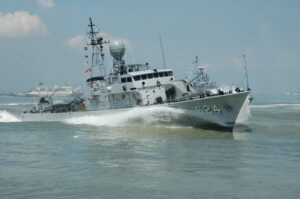
By Indonesian Navy – https://koarmatim.tnial.mil.id/konten/kri-keris-624/, Public Domain, https://commons.wikimedia.org/w/index.php?curid=71453691
Earc-luachrach-class Missile Boat
Entering service in 1972, the Earc-luachrach (newt) class marked a doctrinal shift from the high-speed ‘hit-and-run’ tactics of the earlier Gille-cladaich (Kaulquappe) toward a more sustainable archipelagic presence. Displacing 315 tonnes, the class represented a substantial increase in internal volume, facilitating significantly improved crew habitability and logistical endurance—critical factors for maintaining a distributed ‘lurk’ posture across the Federation’s outer islands.
Description
While the class shared a similar engine output with its predecessors, the increased displacement resulted in a reduced maximum velocity of 33 knots. This marginal loss in speed was deemed a strategic necessity to accommodate an expanded armament suite, which included an eight-cell anti-ship missile (AShM) array and a dedicated point-defense surface-to-air missile (SAM) launcher. Notably, the torpedo tubes of the 1960s era were omitted, reflecting a 1970s naval consensus that prioritized long-range missile saturation over close-quarters kinetic strikes. Features a Link 11 Data Link.
In 1989, the class underwent a comprehensive mid-life modernization (MLU). This upgrade replaced legacy vacuum-tube electronics with integrated solid-state systems, incorporating advanced active/passive sonar, high-resolution fire control radars (FCR), and a modernized Electronic Countermeasures (ECM) suite, ensuring the Earc-luachrach’s relevance into the early 21st century.
- In Service: 1972 – 2015
- Displacement: 315 t standard
- Length/Beam/Draft: 52 m/8,2 m/2,8 m
- Power: 3 x MACO 16V-TDM-453A Diesel engines with 9’600 kW combined, 34 kn, 3 waterjets
- Range: 2’000 nm @ 15 kn
- Complement: 30
- Built: 24
Armament
| Initial | Modernised |
|---|---|
| 4 x twin IUT-15 SSM launchers | 2 x quad IUT-15B SSM launchers |
| 1 x 40 mm md. 52 gun | 1 x 40 mm md. 78 gun |
| 1 x 30 mm/60 md. 60 CIWS | 1 x 30 mm/60 md. 60/85 CIWS |
| 1 x LBT-21 twin launcher (+8 on the magazine) | 1 x 8-cell LBT-21V VLS |
| removable Depth charge/mine rails | removable DC/mine rails |
Sensors
| Initial | Modernised |
|---|---|
| SIOM-45 multipurpose radar | SIOM-42 multipurpose radar |
| SUMA-26 navigation radar | SUMA-37 Surface search/navigation radar |
| RSMT-14 fire control radar | RSMT-32 fire control system |
| CTAI-22 ESM | CTAI-32 ESM |
| CIGA-39 EW Suite | |
| ACNA-24 IFF | ACNA-24 IFF |
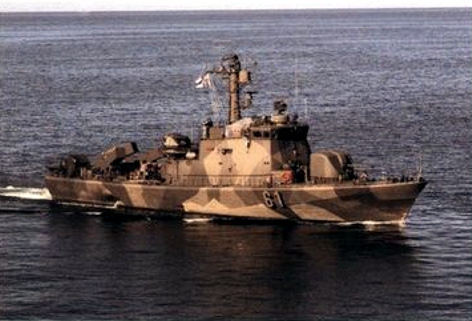
U.S. Navy, Public domain, via Wikimedia Commons
Bradan-class Torpedo Boat
Commissioned in 1960, the Bradan (salmon) class was the Federated Communes’ ambitious response to the increasing tonnage and sensory capabilities of neighboring post-war surface fleets. Displacing 147 tonnes, the Bradan represented a significant scaling-up of the torpedo-boat concept, utilizing a 6,200 kW triple-diesel configuration to maintain a 39-knot sprint capability despite its increased bulk.
Description
The class was designed as a dedicated ‘heavy-strike’ platform, featuring four 550 mm torpedo tubes and the introduction of a twin LARA S MANPADS launcher—one of the Federation’s earliest attempts at integrated organic air defense for small combatants. Ironically, the MANPADS launcher was introduced in 1970 – just a few years before the entire class would be retired, but it offered valuable insight in the challenges of mounting a MANPADS design onto a small and agile ship.
However, the Bradan faced persistent criticism for its ‘all-or-nothing’ armament philosophy. Lacking a medium-caliber main gun, the vessel’s surface defense relied entirely on its twin 30 mm md. 60 CIWS mounts. While effective against aircraft, these lacked the range and kinetic energy to engage enemy torpedo boats or light surface craft effectively. Some of the later versions therefore dropped one of the 30 mm CIWS mounts to mount a 40 mm md. 52 gun at the front of the ship to gain more firepower against other torpedo boats.
Although the class offered vastly superior habitability and sensor range compared to the preceding generation, its strategic utility was quickly eclipsed by the advent of the anti-ship missile. By 1975, the majority of the class had been retired or reassigned to secondary roles, serving as a high-speed technological bridge to the missile era.
- In Service: 1960 – 1975
- Displacement: 147 t standard
- Length/Beam/Draft: 34 m/6,72 m/1,5 m
- Power: 4 x MACO 16V-SDM-343A Diesel engines with 6’200 kW combined, 39 kn, 2 shafts
- Range: 700 nm @ 35 kn, 2000 nm @ 13 kn
- Armament:
- 4 x 550mm torpedo tubes
- 1 x 30 mm/60 md. 60 CIWS (originally 2x)
- 1 x 40 mm md. 52 gun (originally none)
- 1 x 2 Launcher for LBT-64
- removable rails for mines and depth charges
- Sensors:
- SUMA-12 Surface search/Navigation radar
- RSMT-14 fire control radar, Optical Director
- ACNA-10 IFF
- CTAI-12 RWR
- Complement: 21
- Built: 12

By USN – U.S. Navy photo [1] from the USS Intrepid (CVS-11) 1971 cruise book., Public Domain, https://commons.wikimedia.org/w/index.php?curid=21741949
Snas-class torpedo boat
Entering service in 1974, the Snas (dragonfly) class was the Federation’s definitive solution for ultra-high-speed littoral interdiction and clandestine operations. Displacing a mere 30 tonnes, these ‘mosquito’ craft were designed to operate from concealed coastal bunkers and camouflaged inlets rather than traditional naval ports.
While the larger Earc-luachrach provided the fleet’s heavy punch, the Snas focused on pure velocity, utilizing a triple-diesel 2,700 kW powerplant to achieve a blistering 48 knots. Though its torpedo armament was reduced to two 550 mm tubes, the class found its true strategic niche in the delivery and recovery of Communal Marine Commandos. Its shallow 1.5-meter draft and exceptionally low radar cross-section allowed it to penetrate enemy blockades undetected. Despite their limited 300 nm range, the Snas remains in active service as of 2010, serving as the Federation’s primary asset for rapid coastal response and special warfare insertion.
- In Service: 1974 – present
- Displacement: 30 t standard
- Length/Beam/Draft: 19 m/4,42 m/1,0 m
- Power: 2 x MACO 12V-TDM-443G Diesel engines with 3’000 kW combined, 47 kn, 2 waterjets
- Range: 300 nm @ 37 kn
- Armament: 2 x 550mm torpedo tubes, Mines, 1 x 25 mm md. 58
- Sensors: SUMA-12 Surface/Navigation search radar, ACNA-24 IFF
- Electronic Warfare: CTAI-12 RWR
- Complement: 5
- Built: 16
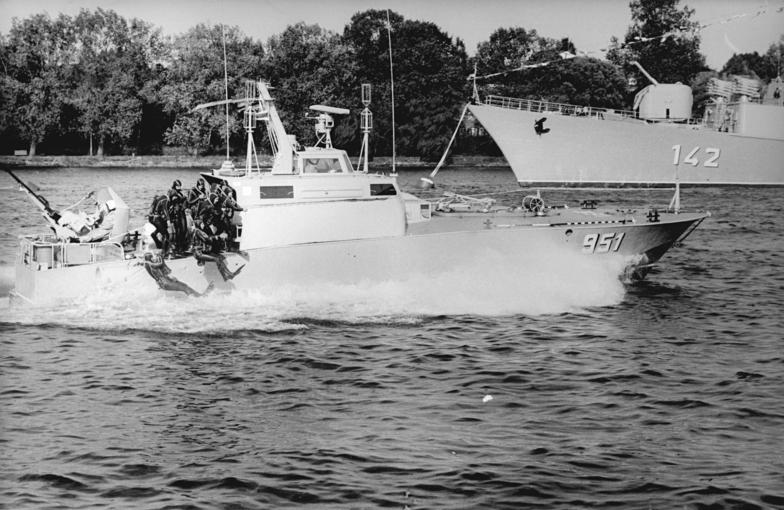
Bundesarchiv, Bild 183-U1004-0013 / CC-BY-SA 3.0, CC BY-SA 3.0 DE https://creativecommons.org/licenses/by-sa/3.0/de/deed.en, via Wikimedia Commons
Corvettes
Àdriana-class Corvette
The Àdriana-class frigates were the first purpose-built anti-submarine warfare (ASW) vessels of the Laywenranian Navy. Introduced in 1955, the class marked a transition from general-purpose wartime-derived hulls to specialized escort vessels optimized for submarine detection and engagement in the context of emerging Cold War threats.
Originally conceived as conventional gun-armed escorts with secondary ASW capability, the class underwent a comprehensive modernization program during its service life in response to evolving threats, including anti-ship missiles and jet aircraft. The upgraded vessels incorporated improved sensors, enhanced ASW systems, and modernized close-in air defense. A total of five ships were commissioned, remaining in service until 1985.
- In Service: 1955 – 1985
- Displacement: 1’500 t standard
- Length/Beam/Draft: 90 m/11 m/4 m
- Power: 6 x MACO 12V-TDM-352 Diesel engines with 15’600 kW combined, 27 kn, 3 shafts
- Range: 7’500 nm @ 15 kn
- Complement: 123
- Built: 6
Armament
| Initial | Modernised |
|---|---|
| 2 x 100 mm md. 53 DP guns | 1 x 100 mm md. 53 DP gun |
| 4 x 25 mm md. 38 AA guns | 2 x 30 mm/60 md. 60 CIWS |
| – | 1 x LBT-1 md. 62B quadruple SAM launcher |
| 1 x LFR-37 md. 55 ASW launcher | 1 x LFR-37 md. 55 ASW launcher |
| – | 2 x twin 400 mm torpedo launchers |
| removable rails for mines and depth charges | removable rails for mines and depth charges |
Sensors and Electronic Warfare
| Initial | Modernised |
|---|---|
| SDCL-13 Hull Sonar | SDCL-13B Hull Sonar |
| SUMA-11 Surface/Low-Air Search Radar | SUMA-11A Surface/Low-Air Search Radar |
| SADS-16 Air Early Warning Radar | SADS-16C Air Early Warning Radar |
| ACNA-10 IFF | RSMT-14 Fire control system |
| CTAI-11 RWR | CTAI-22 ESM |
| CFAD-22 DECM/CFAG-26 OECM | |
| GTAM-25 decoy launcher | |
| ACNA-24 IFF |
_underway_in_1962.jpg#/media/File:French_destroyer_Vauquelin_(D628)_underway_in_1962.jpg)
By U.S. Navy – U.S. Navy photo [1] from the USS Boston (CAG-1) 1962-1963 cruise book available at Navysite.de, Public Domain, https://commons.wikimedia.org/w/index.php?curid=50830106
Siorc-class Corvette
Commissioned in 1963, the Siorc (shark) class was the Federation’s premier ocean-going ASW platform, designed to hunt the increasingly quiet nuclear submarines of the era. Displacing 1,700 tonnes, the Siorc utilized its expanded hull to field a dual-purpose armament of two 100 mm md. 53 DP guns in two turrets.
It was known for its robust CODAD machinery and an exceptional 7,000 nm range. During its mid-life modernization in the 1970s, the Siorc was adapted for the ‘Missile Age.’ The legacy RBW-37 rocket launchers were replaced by the standoff UAW-2 system (delivering an anti-submarine torpedo with a missile to the target area), and the ship’s air defense was bolstered by the addition of a quadruple MLAR-1 SAM launcher. With its specialized dipping sonar and 400 mm torpedo suite, the Siorc remained a respected ‘Predator’ of the deep until its retirement in 1989.
- In Service: 1963 – 1989
- Displacement: 1’700 t standard
- Length/Beam/Draft: 116 m/10,5 m/4,6 m
- Power: 6 x MACO 16V-TDM-353 Diesel engines with 19’200 kW combined, 28 kn, 3 shafts
- Range: 8’000 nm @ 15 kn
- Complement: 170
- Built: 6
Armament
| Initial | Modernised |
|---|---|
| 2 x 100 mm md. 53 DP guns | 1 x 100 mm md. 53 DP gun |
| 2 x 30 mm/60 md. 60 CIWS | 2 x 30 mm/60 md. 60 CIWS |
| 2 x LFR-37 md. 55 ASW launchers | 2 x LFR-37 md. 55 ASW launchers |
| 2 x twin 400 mm torpedo launchers | 2 x twin 400 mm torpedo launchers |
| removable rails for mines and depth charges | removable rails for mines and depth charges |
| 1 x LBT-21 quadruple SAM launcher (+8 magazine) |
Sensors and Electronic Warfare
| Initial | Modernised |
|---|---|
| SDCL-13B Hull Sonar | SDCL-25 Hull Sonar |
| SUMA-11 Surface/Low-Air Search Radar | SUMA-26 Surface search/navigation radar |
| SADS-16 Air Early Warning Radar | SADS-25 Air Search Radar |
| RSMT-14 Fire Control Radar | RSMT-22 Fire control system |
| CTAI-11 RWR | CTAI-22 RWR |
| ACNA-10 IFF | ACNA-24 IFF |
| CFAD-22 DECM/CFAG-26 OECM | |
| GTAM-25 decoy launcher |

By 防衛省・自衛隊ホームページ, CC BY 4.0, https://commons.wikimedia.org/w/index.php?curid=32411767
Mòrag-class corvette
Commissioned in 1980, the Mòrag class was designed to succeed the aging Àdriana and Siorc escorts as the Federation’s primary ASW ship. While significantly smaller than preceding frigate classes, the Katia-class was designed for mass production and long-term fleet utility, forming the backbone of Laywenranian ASW operations into the modern era. Despite its smaller footprint, it retained the 100 mm md. 53 main gun.
Designed for high-volume production, the class became the backbone of the Federation’s ASW doctrine. Its sophisticated sensor suite, including a variable-depth dipping sonar and the UAW-2 standoff launcher, allowed it to hunt modern quiet-running submarines with lethal efficiency. The LAR-21M missile suite provides short-range air defense against aircraft and missiles
- In Service: 1980 – present
- Displacement: 1’350 t standard
- Length/Beam/Draft: 87 m/10,4 m/2,7 m
- Power: 2 x MACO 16V-TDM-463 Diesel engines with 12’000 kW combined, 27 kn, 2 shafts
- Range: 4500 nm @ 15 kn
- Complement: 70
- Built: 20
Armament
| Initial | Modernised |
|---|---|
| 1 x 100 mm md. 69 DP gun | 1 x 100 mm md. 69 DP gun |
| 1 x 30 mm md. 69 CIWS | 1 x 30 mm md. 69 CIWS |
| 2 x 30 mm/60 md.60/80S revolver cannons | 2 x 30 mm/60 md.60/05S revolver cannons |
| 1x LFR-37 md. 55 ASW launcher | 1x LFR-37 md. 55 ASW launchers |
| 1 x LBT-21 quadruple launcher (+16 on magazine) | 1 x LBT-21E quadruple SAM launcher (+16 on magazine) |
| 2 x twin IUT-15 | 2 x twin IUT-15B |
| 2 x twin 400 mm torpedo launchers | 2 x twin 400 mm torpedo launchers |
| removable rails for mines and depth charges | removable rails for mines and depth charges |
Sensors and Electronic Warfare
| Initial | Modernised |
|---|---|
| SDCL-25 Hull Sonar | SDCL-45 Hull Sonar |
| SUMA-37 Surface search/navigation radar | SUMA-37 Surface search/navigation radar |
| SIOM-45 Multipurpose radar | SIOM-42 Multipurpose radar |
| RSMT-22B fire control radar, optical director, Laser rangefinder | RSMT-22D Fire control system |
| CTAI-22 RWR | CTAI-32 RWR |
| CFAD-22 DECM/CFAG-26 OECM | CIGA-39 ECM Suite |
| ACNA-24 IFF | ACNA-24 IFF |
| – | STAS-39 Towed Array sonar |
| GTAM-25 decoy launcher | GTAM-25B decoy launcher |
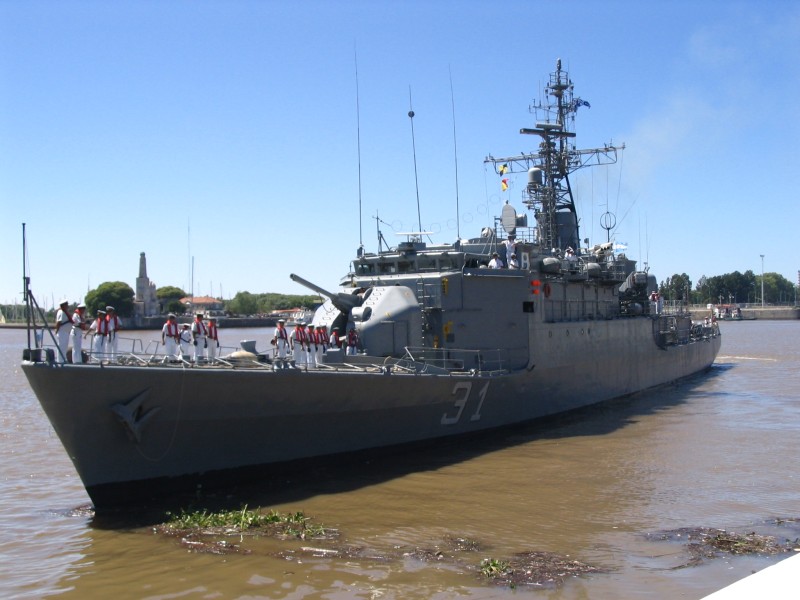
By Martin.Otero – Own work, CC BY 2.5, https://commons.wikimedia.org/w/index.php?curid=2154681
Frigates
Maireann-class frigate
Commissioned in 1958, the Maireann class was the Federation’s successor to the wars fleet destroyers. Designed during an era of transition, the Maireann combined the rugged gun-and-torpedo doctrine of the post-war years with the high-speed requirements of modern screening operations. Displacing 2,380 tonnes and propelled by a 28,000 kW Diesel plant, the class was capable of a sustained 30 knots.
Its defining feature was its offensive versatility: two high-velocity 100 mm md. 53 DP guns the main anti-surface and shore shelling fire power, while its six 550 mm torpedoes allowed it to threaten even the largest cruisers. Throughout the 1960s and 70s, the Maireann served as the flag ship of fast escort fleets, often found leading high-speed interdiction task forces. Though the rise of the anti-ship missile eventually rendered its heavy gun-and-torpedo layout secondary, the class remained in active service until 1981, a testament to its name: The Enduring. A comprehensive Mid-life upgrade saw the replacement of sensors, many of the original weapons systems and the installment of a Combat Management System.
- In Service: 1958 – 1981
- Displacement: 2’380 t standard
- Length/Beam/Draft: 109 m/12 m/4,4 m
- Power: 8 x MACO 16V-TDM-352 Diesel engines with 28’000 kW combined, 30 kn, 4 shafts
- Range: 5’000 nm @ 18 kn
- Complement: 120
- Built: 10
Armament
| Initial | Modernised |
|---|---|
| 2 x 100 mm md. 53 DP guns | 1 x 100 mm md. 53 DP gun |
| 2 x twin 40mm md. 52 AA guns | 2 x 30 mm/55 md. 69 CIWS |
| 2 x twin 25 mm md. 38 AA guns | 1 x LBT-1B quadruple launcher (+16 on magazine) |
| 2 x triple 550 mm torpedo launchers | 2 x twin 400 mm torpedo launchers |
| 1 x LFT-2 ASW launcher (+9 on magazine) | |
| 2 x twin IUT-15 launchers (replacing the 2nd 100 mm) | |
| 1 x LFR-37 md. 55 ASW launchers | 1 x LFR-37 md. 55 ASW launchers |
| removable rails for mines and depth charges | removable rails for mines and depth charges |
Sensors and Electronic Warfare
| Initial | Modernised |
|---|---|
| SDCL-13 Hull Sonar | SDCL-13B Hull Sonar |
| SUMA-11 Surface search/navigation radar | SUMA-26 Navigation radar |
| SADS-16 Air Search radar | SADS-24 Air Search radar |
| RSMT-14 fire control radar | RSMT-22 Fire control system |
| CTAI-12 RWR | CTAI-22 RWR |
| ACNA-10 IFF | ACNA-24 IFF |
| GTAM-13 decoy launcher |
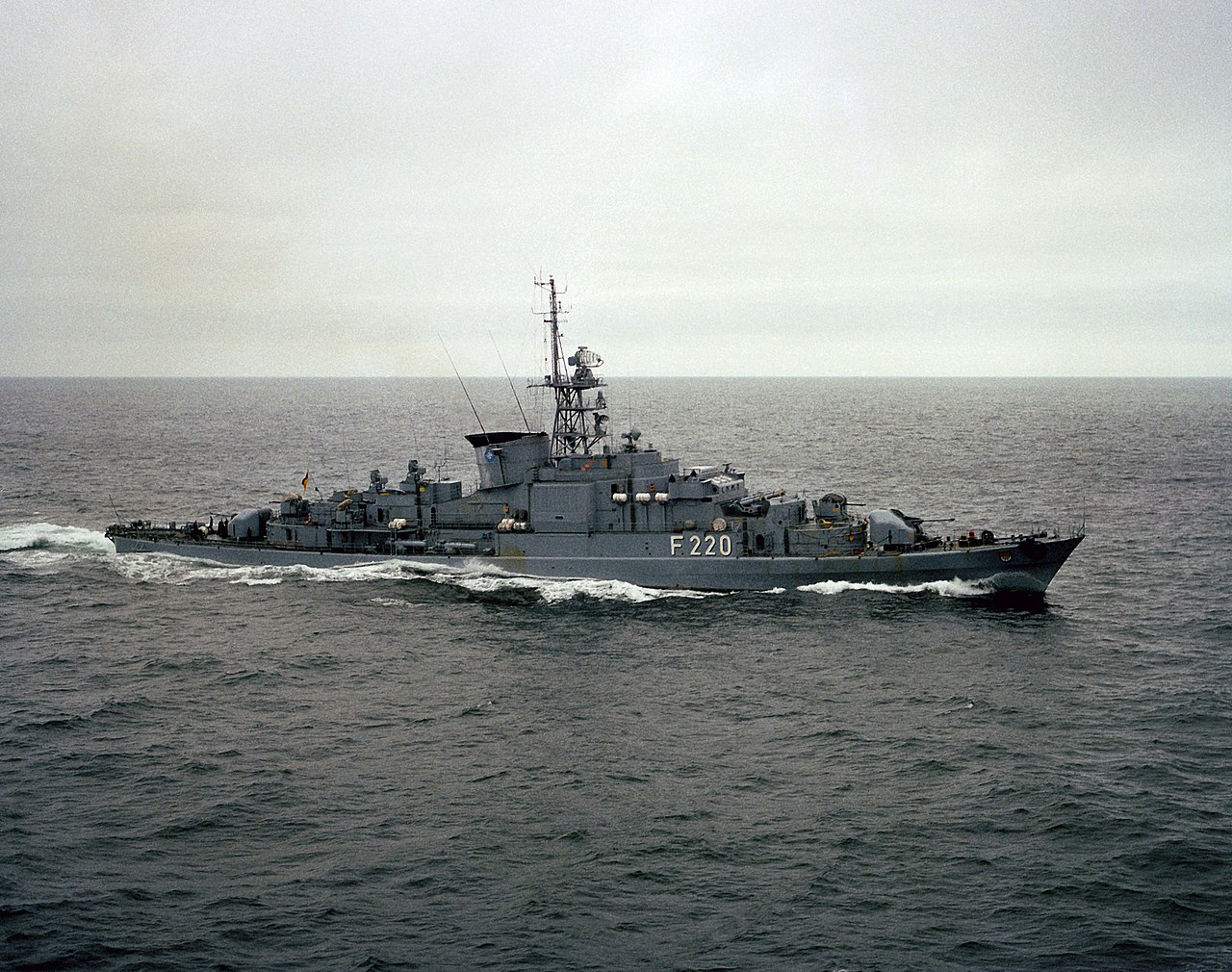
U.S. Navy, Public domain, via Wikimedia Commons
Ceòlraidh-class frigate
Commissioned in 1971, the Ceòlraidh (Spirit or Ghost) class marked the Federation’s transition into the age of the guided-missile frigate. Displacing 3,075 tonnes, it was the largest and most complex escort vessel produced by the Lasaireach Shipbuilding Union (C.L.L.) during the Cold War. The class was designed as a ‘Total Shield,’ capable of providing long-range anti-air, anti-surface, and deep-water anti-submarine protection for the Federation’s vital trade lanes.
The Nèamh-asadh carried an octuple LAR-21 SAM launcher, creating a ‘no-fly zone’ around the escorted ships. Its offensive bite was equally formidable, sporting four ASR-15 subsonic anti-ship missiles. With a sophisticated radar suite and a dual sonar configuration (hull-mounted and towed array), the class served as the primary escort of the navy. While originally intended for a thirty-year service life, the robust CODAD plant and modular sensor bays have allowed the class to remain in front-line service well into the 21st century.
- In Service: 1971 – 2009
- Displacement: 3’075 t standard
- Length/Beam/Draft: 130 m/13,6 m/4,2 m
- Power: 4 x MACO 20V-TDM-463 Diesel engines with 30’000 kW combined, 31 kn, 2 shafts
- Range: 5’000 nm @ 18 kn
- Complement: 201
- Double Hangar for 2 helicopters
- Built: 10
Armament
| Initial | Modernised |
|---|---|
| 1 x 100 mm md. 69 DP gun | 1 x 100 mm md. 69 DP gun |
| 2 x 30 mm md. 69 CIWS | 2 x 30 mm md. 69 CIWS |
| 2 x 30 mm/60 md.60S “Seabhag 30” revolver cannons | 2 x 30 mm/60 md.60/80S “Seabhag 30” revolver cannons |
| 1 x octuple LBT-21 SAM launcher (+24 on magazine) | 1 x 8-cell self-defence VLS (quad-packed LBT-21V) |
| 2 x twin 400 mm torpedo launchers | 2 x twin 400 mm torpedo launchers |
| 1 x LFT-2 ASW launcher (+9 on magazine) | 2 x 16-cell VLS (for LFT-4 and LBT-3M) |
| 2 x quad IUT-15 SSM launchers | 2 x quad IUT-15B launchers |
| removable rails for mines and depth charges | removable rails for mines and depth charges |
Sensors and Electronic Warfare
| Initial | Modernised |
|---|---|
| SDCL-14B Hull Sonar | SDCL-35 Hull Sonar |
| SUMA-26 Navigation radar | SUMA-37 Navigation radar |
| SADS-24 long range Air Search radar | SIOM-41 Multipurpose radar |
| SADS-25 Surface/Low Altitude radar | – |
| RSMT-22 Fire control system | RSMT-22D Fire control system |
| CTAI-22 RWR | CTAI-31 ESM |
| ACNA-24 IFF | ACNA-24 IFF |
| SGTF-13B VDS | SGTF-13C VDS |
| GTAM-25 decoy launcher | GTAM-39 decoy launcher |
| CIGA-39 ECM Suite | |
| META-16 torpedo decoy | META-25 torpedo decoy |

Attribution: Jean-Michel Roche, CC BY-SA 3.0, https://commons.wikimedia.org/w/index.php?curid=60923
Cruisers
Ioma-ghlac-class Cruiser
The Ioma-ghlac-class (Many Grasps) was commissioned in 1960 to serve as the Federation’s primary long-range air defense and command platform. Displacing nearly 6,000 tonnes, it was the first class to utilize a CODOG (Combined Diesel or Gas) propulsion system, granting it a rare combination of 32-knot sprint speeds and an 11,000 nm strategic ferry range.
Designed to counter attacks by jet aircraft and early anti-ship missiles, the class was built around the potent MLAR-2 (later MLAR-3) twin-arm launcher. Its 1985 modernization suite transformed it into a contemporary multi-threat combatant, integrating advanced ELINT sensors and the LAR-21M point-defense system. Despite its age, the hull’s significant volume allowed it to remain the premier flagship of the fleet until its phased retirement in the mid-1990s.
- In Service: 1960 – 1995
- Displacement: 5’720 t standard
- Length/Beam/Draft: 159 m/15,8 m/7,2 m
- Power: CODOG with 2 MACO TuM-48 turbines (17’000 kW each), 2 x MACO 16V-TDM-352 Diesel engines with 7’000 kW combined, 32 kn
- Range: 11’000 nm @ 15 kn
- Complement: 350
- Built: 2
Armament
| Initial | Modernised |
|---|---|
| 2 x 100 mm md. 53 guns | 2 x 100 mm md. 61 guns |
| 1 x twin launcher for LBT-2 (+48 on magazine) | 1 x twin launcher for LBT-3 (+48 on magazine) |
| 1 x quadruple LBT-1 point defence launcher (+20 on magazine) | 1 x LBT-21M octuple launcher (+24 on magazine) |
| 2 x 30 mm md. 60 CIWS | 2 x 30 mm md. 69 CIWS |
| 4 x 25 mm md. 51 cannons | 2 x 30 mm/60 md.80S “Seabhag 30” revolver cannons |
| 2 x twin IUT-04 SSM launchers | 2 x twin IUT-15 SSM launchers |
| 2 x twin 400 mm torpedo launchers | 2 x twin 400 mm torpedo launchers |
| mine rails | mine rails |
Sensors
| Initial | Modernised |
|---|---|
| SATS-13 3D Air search radar | SATS-13A 3D Air search radar |
| RSMT-25 Fire control radar | RSMT-25B Fire control radar |
| SUMA-11 Surface/Air search radar | SIOM-41 multipurpose radar |
| SUMA-12 Surface search/navigation radar | SUMA-26 navigation radar |
| SDCL-14 hull sonar | SDCL-14B hull sonar |
| SGTF-13 variable depth sonar | SGTF-13C variable depth sonar |
| ACNA-10 IFF | ACNA-24 IFF |
| CTAI-11 RWR | CTAI-31 ESM |
| GTAM-13 decoy launcher | GTAM-25 decoy launcher |
| CIGA-39 EW Suite | |
| META-16 torpedo decoys | META-25 |
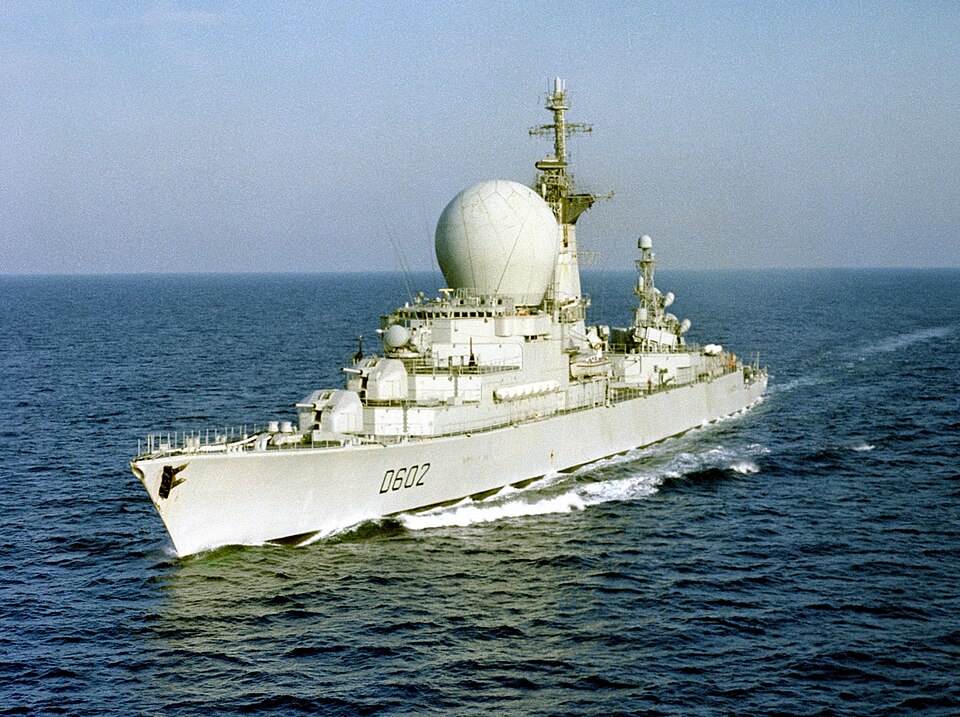
USN, Public domain, via Wikimedia Commons
Seabhag-class Cruiser
Commissioned in 1974, the Seabhag-class was designed to provide a high-speed, long-range command and control (C2) hub with a primary emphasis on deep-water Anti-Submarine Warfare (ASW). Displacing 5,720 tonnes, the hull was widened to 15,5 meters to accommodate a dual-hangar facility and improve stability for high-sensitivity sonar operations. The class utilized a sophisticated CODOG propulsion system, allowing it to transition from 11,000 nm economical cruising to a 31-knot sprint for carrier escort duties.
The design’s primary innovation was the integration of a dual-helicopter hangar and a massive Variable Depth Sonar (VDS) suite, allowing the ship to act as the fleets heavy ASW platform.
- In Service: 1974 – 2003
- Displacement: 4’720 t standard
- Length/Beam/Draft: 155 m/15,5 m/5,6 m
- Power: CODOG with 2 MACO TuM-48B turbines (20’000 kW each), 2 x MACO 16V-TDM-463 Diesel engines with 12’000 kW combined, 31 kn, 4 shafts
- Range: 11’000 nm @ 15 kn
- Complement: 350
- Hangar for 2 helicopters
- Built: 2
Armament
| Initial | Modernised |
|---|---|
| 2 x 100 mm md. 69 guns | 2 x 100 mm md. 69 guns |
| 1 x LBT-21 octuple launcher (+28 on magazine) | 2 x 8-cell self-defence VLS (LBT-21V quad-pack) |
| 2 x 30 mm md. 69 CIWS | 2 x 30 mm md. 69 CIWS |
| 2 x 30 mm/60 md.60S “Seabhag 30” revolver cannons | 2 x 30 mm/60 md.60/80S “Seabhag 30” revolver cannons |
| 2 x quad IUT-15 SSM launchers | 2 x quad IUT-15 SSM launchers |
| 1 x LFT-2 ASW launcher | 2 x 16-cell VLS (LBT-3, LFT-4) |
| 2 x triple 400 mm torpedo launchers | 2 x triple 400 mm torpedo launchers |
| removable mine rails | removable mine rails |
Sensors
| Initial | Modernised |
|---|---|
| SADS-24 Long Range Air search radar | SADS-24C Long Range Air search radar |
| SADS-25 Air search radar | SIOM-41 multipurpose radar |
| RSMT-22 Fire control radar | RSMT-22C Fire control radar |
| SUMA-26 Surface search/navigation radar | SUMA-37 navigation radar |
| SDCL-14B hull sonar | SDCL-35 hull sonar |
| SGTF-13B variable depth sonar | SGTF-13C variable depth sonar |
| – | STAS-39 towed array sonar |
| ACNA-24 IFF | ACNA-24 IFF |
| CTAI-22 RWR | CTAI-31 ESM-Suite |
| GTAM-25 decoy launcher | GTAM-39 decoy launcher |
| CFAD-22 DECM | CIGA-39 EW-Suite |
| CFAG-26 OECM | X |
| META-16 torpedo decoys | META-25 torpedo decoys |

Attribution: Jean-Michel Roche, CC BY-SA 3.0, https://commons.wikimedia.org/w/index.php?curid=48534
Submarines
Halabat-class Submarine
The Halabat-class (Halibut) was commissioned in 1952 as an evolutionary successor to the earlier war designs. The class was specifically engineered to address the increasing sophistication of anti-submarine sensors by prioritizing a drastically increased diving depth and a reduced acoustic signature. Displacing 1,500 tonnes (surfaced), it was a formidable ocean-going platform capable of long-duration interdiction missions. Its reinforced pressure hull allowed for a 280-meter diving depth, a significant strategic advantage that permitted the Halabat to utilize deep-water thermal layers to evade surface sonar.
The Halabat utilized a double-hull construction with high-tensile steel alloys, a necessity for achieving the 300-meter depth rating. This depth was nearly double that of many World War II-era fleet boats, providing the Federation with a “silent” layer of defense.
To reduce sound emission, the C.L.L. engineers implemented the first generation of “Raft-Mounting” for the diesel engines—isolating the vibrating machinery from the hull with rubber dampeners. While primitive compared to later 1980s designs, it made the Halabat one of the quietest submarines in the region during the 1950s.
- In Service: 1953 – 1977
- Displacement: 1’500 t surfaced
- Length/Beam/Draft: 77 m/7 m/5,1 m
- Power: 2 × MACO 16V-SDM-343 diesel engines (1,300 kW each), diesel-electric propulsion, 16 kn surfaced / 14 kn submerged
- Range: 9’600 nm surfaced @ 9 kn
- Armament: 6x 550mm bow Torpedo Launchers, 2x 550mm stern Torpedo Launchers, 22 Torpedoes or 40 Mines
- Sensors: SDCL-U1 active and passive sonar (bow and flank arrays), ESM, echolot, radar
- Complement: 54
- Endurance: 45 days, 4 days submerged
- Diving Depth: 280 m
- Built: 8

Public Domain, https://commons.wikimedia.org/w/index.php?curid=2352127
Silis-class Submarine
Introduced in 1969, the Silis-class (catfish) was the Federation’s first “True Submarine.” Departing from the sharp, ship-like bows of previous eras, the class utilized a rounded, hydrodynamic “whale-shaped” hull to minimize drag and acoustic turbulence. To further reduce its signature, the C.L.L. pioneered the use of an external anechoic rubber coating, designed to absorb active sonar pulses from enemy escorts. With a significantly expanded battery bank and a streamlined sail, the Silis could sustain 18 knots submerged.
The Silis abandoned the twin-screw layout of its predecessors for a single, large-diameter propeller on the centerline. This configuration, combined with the teardrop hull, drastically reduced the cavitation threshold, allowing the submarine to move faster before being detected. The “teardrop” geometry also improved stability during high-speed underwater maneuvers. The application of rubber tiling across the hull was a major technological hurdle for the C.L.L. shipyards. This coating served a dual purpose: it dampened the internal noise of the 73-man crew and machinery, and it significantly reduced the “Return Echo” of enemy active sonar, making the Silis a “ghost” in the archipelago’s complex acoustic environment. To support the 18-knot submerged dash, the internal volume was dominated by massive lead-acid battery compartments. This allowed the Silis to remain fully submerged for 8 days—double the endurance of the Halabat—making it an ideal platform for long-range ambushes in the North Reach.
- In Service: 1969 – 1992
- Displacement: 1’900 t standard surfaced
- Length/Beam/Draft: 72,7 m/9,9 m/7,4 m
- Power: 2 × MACO 16V-SDM-343A diesel engines (1,550 kW each), diesel-electric propulsion, 12 kn surfaced / 20 kn submerged
- Range: 6’000 nm @ 12 kn
- Armament: 6x 550mm bow Torpedo Launchers, 22 Torpedoes or 28 Mines
- Sensors: SDCL-U3 active sonar/passive sonar (bow & flank arrays), CTAI-22 ESM, echolot, radar
- Complement: 71
- Endurance: 45 days, 8 days submerged (snorkel)
- Diving depth: 300 m
- Built: 6
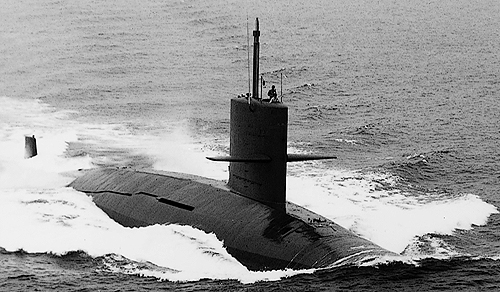
By 防衛省・自衛隊ホームページ, CC BY 4.0, https://commons.wikimedia.org/w/index.php?curid=32561683
Tarr-geal-class Submarine
Commissioned in 1980, the Tarr-geal (White Belly – a traditional name for deep-dwelling fish) served as the Federation’s premier patrol submarine for three decades. Unlike the long, lean hulls of the 1950s, the Tarr-geal utilised a high-beam, “fat” teardrop geometry that prioritized internal volume for advanced computer processing and high-capacity battery banks. This class moved the Federation into the era of the “Submerged Missile Platform,” introducing the ability to launch both anti-ship and land-attack cruise missiles while remaining at depth. With a vastly improved acoustic signature and a 20-knot submerged sprint, it was designed to “lurk” in the deep trenches of the North Reach, acting as a hidden deterrent against both surface fleets and coastal infrastructure.
Description
With a length-to-beam ratio of nearly 7.7:1, the Tarr-geal is significantly broader than its predecessors. This “whale-like” shape (inspired by the late-Cold War shift toward shorter, fatter hulls) provides exceptional maneuverability and allows for a massive internal battery deck located beneath the crew quarters.
The Reduced Emissions requirement led the C.L.L. engineers to develop the “Silent Snorkel” system—utilizing advanced exhaust scrubbers and underwater diffusers to break up the heat signature and bubbles of the diesel engines. Internally, every piece of machinery—down to the kitchen galleys—was mounted on a “Double-Resilient” floating cradle to prevent vibration from reaching the outer hull.
To achieve 20 knots silently, the Tarr-geal utilized a highly skewed, seven-bladed “scimitar” propeller. This design prevents the formation of vacuum bubbles (cavitation) at high speeds, allowing the submarine to sprint between patrol sectors without “ringing the bell” for enemy sonobuoys.
- In Service: 1980 – 2010
- Displacement: 2’100 t surfaced
- Length/Beam/Draft: 76,0 m/9,9 m/7,4 m
- Power: 2 × MACO 16V-TDM-453G diesel engines (2,000 kW each), diesel-electric propulsion, speed of 12 knots surfaced and 20 knots submerged
- Range: with snorkel 8’000 nm @ 7 kn, submerged 500 nm @ 3 kn
- Armament: 6x 550mm bow Torpedo Launchers, 18 Torpedoes, 24 Mines, land attack cruise missiles, anti-ship missiles
- Sensors: SDCL-U3 bow sonar (active/passive), SDFL-U3 flank arrays, CTAI-31 ESM, echolot, radar
- Complement: 72
- Diving depth: 300 m
- Built: 6
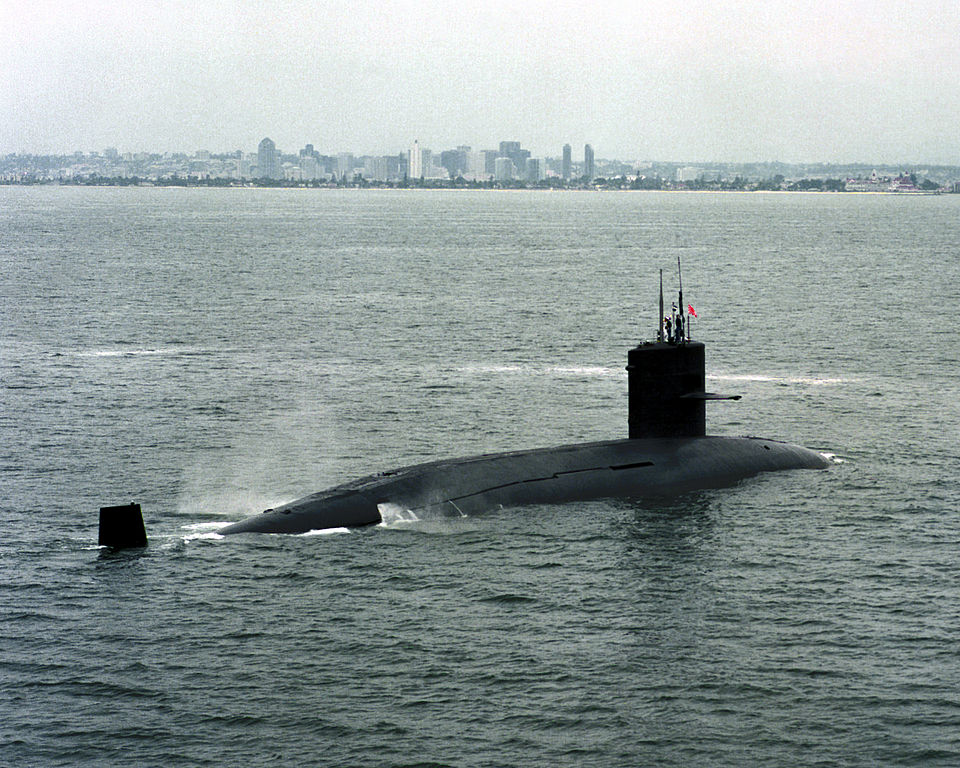
PH2 Carmen Yebba, U.S. Navy, Public domain, via Wikimedia Commons
Mine countermeasure ships
Crùban-Creige-class minesweeper
The Crùban-Creige-class (Rock Crab) was a series of wooden-hulled coastal minesweepers (MSC) and minelayers commissioned between 1955 and 1975 to provide littoral defense and mine countermeasures within the complex geography of a tropical archipelago. Designed after the Third Cataclysm, the class was a response to the proliferation of sophisticated naval mines that utilized magnetic and acoustic influence sensors. To counter these threats, the vessels utilized advanced non-ferrous construction techniques.
Description
The hallmark of the Crùban-Creige design was its composite multi-layered wooden hull, an engineering necessity to achieve a low magnetic signature. The hull was constructed using a double-diagonal planking method, utilizing high-density teak and mahogany over a structural skeleton of aluminum alloy frames. This specific choice of timber was dictated by the operational environment; the hardwoods offered natural resistance to the humid climate and the localized threat of Teredo navalis (shipworms), which frequently compromised softer woods in tropical waters. At a standard displacement of 280 tonnes and a length of 47 meters, the vessels maintained an exceptionally shallow draft of 2.2 meters. This allowed the class to “scuttle” into shallow lagoons and over coral sandbars, effectively hiding from larger surface threats while maintaining a vantage point for minelaying or sweeping operations.
The class was equipped with a versatile suite of weaponry and sensors to fulfill its dual role as both a “sweeper” and a “layer.” Primary air defense and surface engagement were provided by a single 40 mm md. 52 anti-aircraft gun mounted on the forecastle, a reliable and manually operated system capable of detonating surfaced mines or deterring light aircraft. For its primary mission, the aft deck was fitted with mechanical “Oropesa” cutting sweeps for moored mines and modular rails for the deployment of contact mines. Sub-surface detection relied on a high-frequency, hull-mounted sonar optimized for identifying “mine-like objects” on the seabed. Defensively, the class was fitted with a Radar Warning Receiver (RWR), a critical piece of electronic warfare kit for the era that provided the crew with early warning of enemy radar “painting” the ship, allowing the wooden vessel to leverage its low profile and retreat into the radar clutter of the archipelago’s mountainous islands.
- In Service: 1955 – 1975
- Displacement: 280 t standard
- Length/Beam/Draft: 47,1 m/7,2 m/2,2 m
- Power: 2 × MACO 12V-SDM-333 diesel engines (950 kW each), 1,900 kW combined, 23 kn
- Range: 1’250 nm @ 15 kn
- Armament: 1 x 40 mm md. 52 AA gun, Mines, DCs
- Sensors: SCDL-14W Sonar, SUMA-11 Surface/Navigation Search radar
- Electronic Warfare: CTAI-12 RWR, ACNA-10 IFF
- Complement: 31
- Built: 16
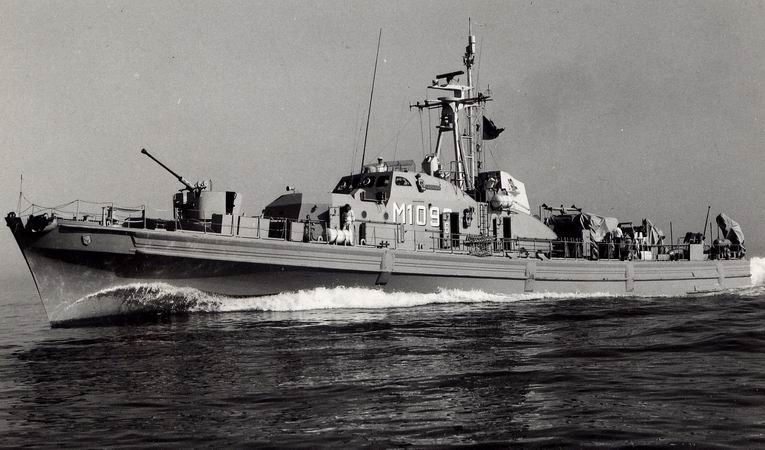
Von Ullischnulli (Ulrich Stelzner) – Eigenes Werk, CC BY-SA 3.0, https://commons.wikimedia.org/w/index.php?curid=287212
An Gath-Dubh-class minesweeper
The An Gath-Dubh-class (Stingray) represented a significant technological leap in littoral warfare for the archipelago, succeeding the Crùban-Creige as the primary defensive asset for shallow-water operations. Entering service in 1970, the class was designed to meet the evolving threats of the late Cold War, where high-speed missile boats and advanced influence mines necessitated a more agile and technologically dense platform. While smaller in displacement than its predecessor at 200 tonnes, the Sian-Mhara integrated automated fire control and a vastly improved endurance profile, allowing the fleet to maintain a persistent presence across the outermost reaches of the archipelago. The class remained the frontline standard for coastal sovereignty until the mid-1990s, when they were eventually phased out in favor of multi-role corvette designs.
Description
In a departure from traditional timber construction, the Sian-Mhara-class was among the early adopters of Glass-Reinforced Plastic (GRP) for its primary hull structure. By the late 1960s, GRP had become a viable material for naval architecture, offering a completely non-magnetic signature and superior resistance to the corrosion and osmotic blistering typical of tropical environments. The monolithic GRP hull provided an exceptional strength-to-weight ratio, allowing for a broader 7.7-meter beam on a relatively short 40.5-meter frame. This design choice resulted in a highly stable platform with an ultra-shallow draft of only 1.6 meters, specifically engineered to navigate over sensitive coral reefs and through silted estuarine waters that would be impassable to contemporary steel or even wooden vessels.
The propulsion system of the Sian-Mhara was remarkably powerful for its size, featuring two high-output diesel engines delivering a combined 3,100 kW. This enabled a top speed of 24 knots, providing the necessary “sprint” capability for rapid response to territorial incursions. More notable, however, was the class’s strategic endurance; by optimizing the hull form for fuel efficiency at lower speeds, the vessels achieved a range of 2,400 nautical miles at 10 knots.
The class was defined by its integration of early-generation digital combat systems, specifically designed to counter the threat of anti-ship missiles and low-flying aircraft. The primary armament consisted of a 30 mm md. 60 Close-In Weapon System (CIWS), which was linked to a dedicated Fire Control System (FCS) and radar suite. This automated capability provided a layer of point defense that was previously unavailable to coastal sweepers, allowing the Sian-Mhara to survive in higher-threat environments. For its mine-warfare role, the ship retained aft-mounted rails for both mine-laying and depth charge deployment, supported by a modernized sonar suite capable of high-resolution seafloor mapping, as well as acoustic and magnetic sweep gear.
- In Service: 1970 – 1995
- Displacement: 200 t standard
- Length/Beam/Draft: 40,5 m/7,7 m/1,6 m
- Power: 2 x MACO 16V-SDM-343A Diesel engines (1’550 kW each), 3’100 kW combined, 24 kn
- Range: 2400 nm @ 10 kn
- Armament: 1 x 30 mm/60 md. 60 CIWS, Rails for Mines and Depth Charges
- Sensors: SDCL-13F Sonar, DRVN-32 Surface/Navigation Search radar, DRBC-33 FCS for CIWS
- Electronic Warfare: CTAI-22 ESM, ACNA-24 IFF
- Complement: 27
- Built: 12
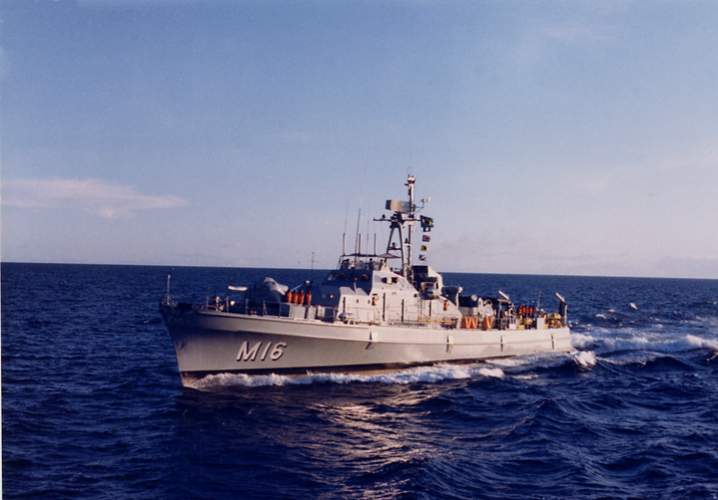
Auxiliary Ships
An t-Àiteach-class Fleet Replenishment Tanker (AO)
The An t-Àiteach-class (Replenishment) was the cornerstone of the archipelago’s post-war naval expansion, commissioned in 1952 to provide the logistical “bridge” between shore-based depots and the frontline fleet. Unlike the small, coastal tankers of the pre-war era, the An t-Àiteach was designed to supply and shuttle fuel to task forces and Tankers. This required the vessel to maintain pace with high-speed surface combatants, including the navy’s surviving heavy units—its Third-Cataclysm-era aircraft carriers and battlecruisers—who demanded constant resupply to maintain a presence in the outer archipelago.
Description
To meet the requirements of a diverse fleet, the An t-Àiteach-class featured a high-volume, subdivided hull of welded steel construction. Measuring 115 meters in length with a deep 7.2-meter draft, the ships were significantly larger than contemporary coastal auxiliaries. Because they were tasked with fueling 6,000-tonne destroyers and capital ships in open sea states, the class was equipped with advanced active stabilization systems to minimize roll during replenishment operations. The propulsion system was built for endurance and “sprint” capability, utilizing a 3,500 kW diesel-electric plant that allowed the tanker to maintain a steady 16 knots—sufficient to stay within the protective screen of a carrier task group during transit.
The primary mission of the An t-Àiteach was Underway Replenishment (UNREP), executed via two heavy-duty amidships gantries. The class was a “multi-product” auxiliary, capable of transferring several types of liquid cargo simultaneously:
- Marine Diesel: For the ubiquitous Laywenranian Diesel Engines equipping almost of the naval vessels. (~12’000 m³)
- Aviation Fuel: Specialized high-pressure lines were dedicated to supplying the carrier air groups. (~3’000 m³)
- Fresh Water: Vital for long-duration tropical patrols where onboard desalination was limited. (~1’000t)
Beyond liquids, the class featured a specialized aft deck for Light Jackstay transfers, allowing for the delivery of mail, medical supplies, and personnel between ships without the need for a harbor visit.
- In Service: 1952 – 1985
- Displacement: 8’500 t full load
- Length/Beam/Draft: 115 m/16,8 m/7,2 m
- Power: 2 x MACO 06V-TDM-342 Diesel engines (1’300 kW each), 2’600 kW combined, 16 kn, 2 shafts
- Range: 9’500 nm @ 12 kn
- Armament: 2 x twin 40 mm/80 md. 52, 4 x twin 25 mm/80 md. 38, 2 x 13 mm machine guns, after 1975: 2 x 30 mm/55 md. 69 CIWS replacing 25 mm guns
- Sensors: CTAI-12 RWR, RSMT-14 Fire control System, ACNA-10 IFF, after 1975: SUMA-26 Navigation radar
- Complement: 140
- Built: 4

U.S. Department of Defense Current Photos, Public domain, via Wikimedia Commons
Obair-class Fleet Support Vessel
The Obair-class (“Work-class”) entered service in 1958 as the Federation’s first purpose-built fleet support ship, replacing wartime ammunition hulks and repair barges with a versatile platform for general stores, munitions, and at-sea maintenance. Designed for dispersed archipelago operations, the class featured extensive crane facilities, onboard workshops, and modular cargo holds to sustain forward-deployed task groups without port access. While lacking underway replenishment (UNREP) rigs—reserved for dedicated oilers—the Obair vessels proved indispensable for supplying the distributed corvettes and frigates operating in the archipelago.
- In Service: 1958 – 1985
- Displacement: 3’200 t full load
- Length/Beam/Draft: 98 m/14 m/4,5 m
- Power: 2 × MACO 12V-TDM-352 diesel engines (2,600 kW each) with 5,200 kW combined, 18 kn, 2 shafts
- Range: 7,500 nm @ 14 kn
- Complement: 85
- Armament: 2 × twin 40 mm md. 52 AA, 4 × 25 mm md. 38 (replaced by 2 x 30 mm/55 md. 69 CIWS)
- Sensors: RSMT-14 Fire control System, SUMA-11 Search/Navigation radar, ACNA-10 IFF, CTAI-12 RWR
- Cargo Capacity: 1,200 t dry stores (ammo, spares, provisions), 2 × 20t cranes, workshop bay (torpedo/mine repair)
- Built: 6

U.S. Navy photo by Mass Communication Specialist 1st Class R. David Valdez, Public domain, via Wikimedia Commons
Mòr-sholar-class Fast Combat Support Vessel
The Mòr-sholar-class (literally “Great Provider”) was the Federation’s response to the “Speed Crisis” of the early 1960s. While the earlier An t-Àiteach-class was a reliable workhorse, it lacked the sprint capability to stay within the defensive screen of a Carrier Task Group (CTG) performing high-speed maneuvers.
Description
Commissioned in 1964, the Mòr-sholar was the largest and most complex vessel ever built by the archipelago’s domestic yards. It moved away from the “tanker with a few crates” philosophy and embraced the AOE (Fast Combat Support) concept: a single hull capable of providing everything a Shokaku-class carrier and its battlecruiser escorts needed to sustain a 30-day high-intensity offensive.
The hull was fine for a logistics ship, featuring a bulbous bow to reduce drag and a massive, reinforced midsection to house the “Heavy UNREP” (Underway Replenishment) stations. This allowed the ship to maintain its speed even in the heavy swells of the outer archipelago. The class was designed to replenish two ships simultaneously—one on each beam. Its signature features were the four high-speed Heavy Jackstay gantries.
- Aviation Support: Unlike the An t-Àiteach, the Mòr-sholar could transfer JP-5 jet fuel at double the flow rate, critical for getting a carrier’s air wing back into the fight.
- Ammunition Support: Dedicated climate-controlled magazines and heavy-lift elevators were installed specifically to handle the 280mm shells for the battlecruisers and the sensitive LBT-21 surface-to-air missiles for the new AA cruisers.
- VERTREP: The aft deck featured a massive landing pad and hangar for two medium-lift helicopters, allowing for “Vertical Replenishment” of dry stores while the tanker was busy pumping fuel.
- Service: 1964 – 1991
- Displacement: 14,500 t (Standard) / 23,800 t (Full Load)
- Length / Beam / Draft: 182 m / 24.5 m / 9.8 m
- Power: 4 x MACO 12V-TDM-272 Diesel engines (7’500 kW each), 30’000 kW combined, 26 kn, 4 shafts
- Range: 8’200 nm @ 16 kn
- Complement: 280
- Liquids: 15,000 m³ Marine Diesel; 4,500 m³ JP-5 Aviation Fuel; 1,200 t Fresh Water.
- Solids: 2,500 t (Munitions, Spare Parts, Refrigerated Provisions).
- UNREP Stations: 4 x Liquid Transfer; 2 x Heavy Jackstay (for 280mm shells/Missiles).
- Armament: 2 x twin 40 mm md. 52, 4 x 25 mm md. 38 (after 1975: replaced by 2 x 30 mm/55 md. 69 CIWS)
- Sensors: CTAI-12 RWR, ACNA-10 IFF, after 1975: SUMA-26 Navigation radar
- Aviation: Aft hangar for 2 x heavy-lift helicopters.
- Built: 2
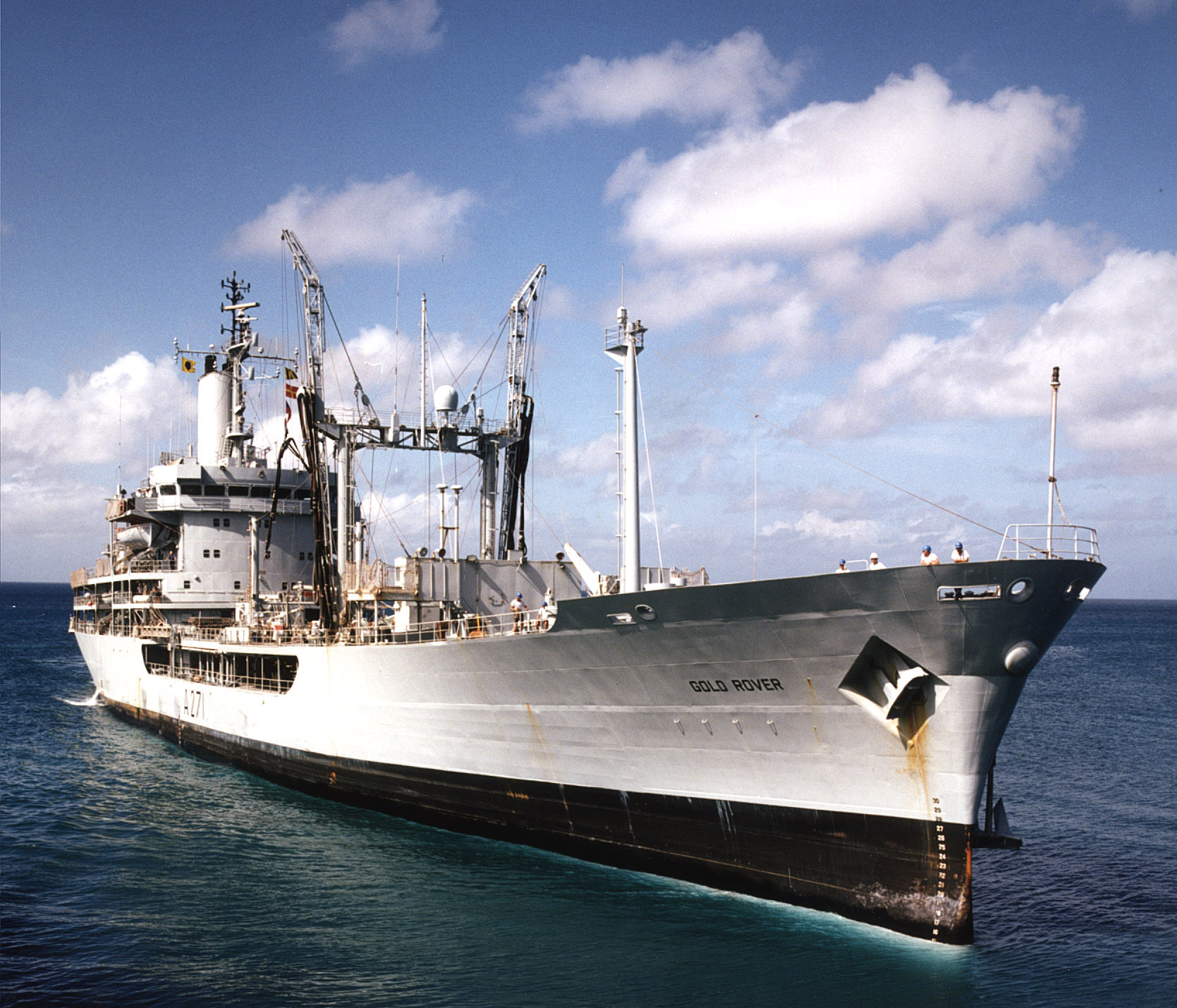
Photo: Royal Navy/MOD, OGL v1.0OGL v1.0, via Wikimedia Commons
Sgàth-class Tender
The Sgàth-class (“Shadow,” “Shelter,” or “Protection”) was developed in the early 1960s as a direct response to the Federation’s shift toward Green-Water Denial. With the introduction of high-speed Fast Attack Craft (FAC), the Navy realized these “mosquito” fleets could only operate effectively if they had a mobile sanctuary to return to for fuel, re-arming, and crew rest.
Description
Built on the proven Obair-class hull, the Sgàth stripped away general cargo space to become a specialized “Mother Ship.” It functioned as a floating barracks, a high-speed fueling station, and a sophisticated ordnance depot, allowing FAC flotillas to strike hundreds of miles beyond their home ports.
The Sgàth was designed to act as the center of a “Nest.” In a sheltered cove or a remote island lee, the tender would anchor, and up to four FACs would moor alongside simultaneously (two on each beam).
- Personnel Support: FAC crews lived in cramped, noisy conditions. The Sgàth provided high-quality “Hotel” facilities, including hot showers, a large galley, and a 210-berth “rotation deck” where FAC crews could sleep in silence while the tender’s technicians maintained their boats.
- Ordnance Handling: The midships holds were converted into specialized magazines for torpedoes and the first generation of anti-ship missiles. Using the Obair‘s heavy-duty cranes, the tender could re-arm a boat in under 30 minutes.
- Technical Workshops: The ship featured precision machine shops capable of overhauling the high-performance, high-maintenance engines used by the FACs.
- Service: 1962 – 1993
- Displacement: 3,450 t (Full Load)
- Length / Beam / Draft: 98 m / 14 m / 4,8 m
- Power: 2 × MACO 12V-TDM-352 diesel engines (2,600 kW each) with 5,200 kW combined, 18 kn, 2 shafts
- Range: 6,500 nm @ 12 kn
- Complement: 95 (Accomodation for additional 210)
- Liquids: 800 t High-grade Diesel; 100 t Lubricating Oils; 150 t Fresh Water.
- Ordnance: Racks for 40 Heavy Torpedoes or 24 Anti-Ship Missiles.
- Support: 2 x 20t Cranes; 4 x specialized alongside refueling booms; 1 x reinforced fender system (to prevent hull damage during alongside mooring in rougher seas).
- Armament: 2 × twin 40 mm md. 52 AA, 4 × 25 mm md. 38 (later replaced by 2 x 30/55 mm md. 69 CIWS)
- Sensors: CTAI-12 RWR, GTAM-13 decoy launcher, ACNA-10 IFF
- Built: 4
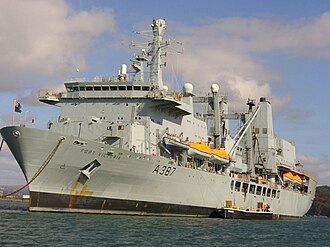
Dmgerrard at English Wikipedia, CC BY-SA 3.0 https://creativecommons.org/licenses/by-sa/3.0, via Wikimedia Commons
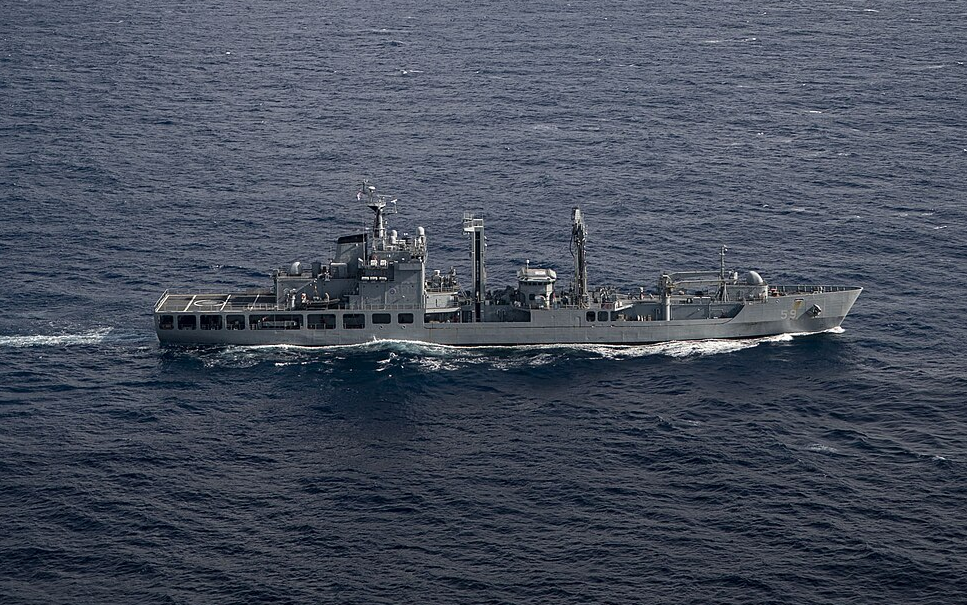
Saorsa-class AOR
The Saorsa-class (liberty) auxiliary oiler replenishment ships entered service with the Laywenranian Navy in 1982 as replacements for the An t-Àiteach-class fleet replenishment tankers and partial successors to the Obair-class fleet support vessels. These ships combined liquid fuel transfer with limited dry stores replenishment capability, enabling sustained operations of task groups and escort screens without reliance on shore facilities. Three vessels were constructed to support the Federation’s blue-water deployments during the final decades of the 20th century. The class is notable for introducing mid-course missile replenishment capabilities and automated liquid cargo handling to the auxiliary fleet. The internal layout is highly compartmentalized to allow for the simultaneous transport of diverse cargo types. The ships utilize a double-bottom hull in the vicinity of the fuel tanks to mitigate the risk of environmental contamination in the event of minor collisions or groundings in the archipelago’s restricted waters.
- Service: 1979 – 2017
- Displacement: 19,000 t full
- Length/Beam/Draft: 170 m/22 m/8 m
- Power: 2 × MACO 16V-TDM-472 (8,800 kW each), CODAD, 22 kn
- Range: 10,000 nm @ 18 kn
- Complement: 180
- Armament: 2 x 30 mm/55 md. 69 CIWS
- Sensors: SUMA-37 Surface/Navigation radar, RSMT-22B Fire control system, CTAI-31 ESM, ACNA-24 IFF, GTAM-39 decoy launcher
- Cargo: 15,000 m³ diesel + 5,000 m³ avgas + 1,500 t solids
- UNREP: 4 × heavy stations (2 ships alongside)
- Aviation: Hangar + deck for 2 × Medium Lift Helicopters
- Built: 3 ships
Diego Quevedo Carmona, CC BY-SA 3.0 https://creativecommons.org/licenses/by-sa/3.0, via Wikimedia Commons
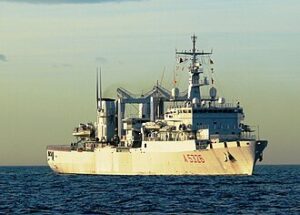
Lùth-class AFS Combat Store Shop
The Lùth-class (surge) combat stores ships entered service with the Laywenranian Navy in 1980 as replacements for the original Obair-class fleet support vessels. These ships provided dry cargo replenishment including ammunition, provisions, and spare parts to surface combatants and auxiliaries during extended deployments. Four vessels were constructed to support task force operations in the outer archipelago and beyond.
The Obair-II-class hull design incorporated reinforced deck structures to support heavy-lift pallet transfer during underway replenishment operations. Cargo was organized across multiple climate-controlled magazines and general stores holds, with dedicated elevators serving the main deck transfer stations. The propulsion system provided sufficient speed to maintain station with 24-knot groups while conserving fuel for extended transits. Self-defense systems were sized for protection against missile-armed fast attack craft encountered during replenishment evolutions. Vertical replenishment capability extended operational flexibility in conditions limiting alongside transfers. The class continues operational service with periodic sensor and electronics upgrades.
- Service: 1980 – present
- Displacement: 9,000 t full
- Length/Beam/Draft: 142 m/19 m/6 m
- Power: 2 × MACO 16V-TDM-472 (8,800 kW each), CODAD, 24 kn, 2 shafts
- Range: 10,000 nm @ 18 kn
- Complement: 140
- Armament: 2 x 30 mm/55 md. 69 CIWS, 2 x 30 mm/60 md.60/80S “Seabhag 30” revolver cannons
- Sensors: SUMA-37 Surface/Navigation radar, RSMT-22B Fire control system, CTAI-31 ESM, ACNA-24 IFF, GTAM-39 decoy launcher
- Cargo: 4,000 t dry stores in modular containerized bays
- UNREP: 2 × heavy jackstay stations
- Aviation: Hangar + deck for 2 × Medium Lift Helicopters
- Built: 4 ships (Lùth -Surge, Sgeir – Reef, Ceò – Mist, Lionadh – Flood Tide)
U.S. Navy photo by Petty Officer 1st Class Chris Williamson, Public domain, via Wikimedia Commons
Sgùrr-class Landing Helicopter Dock (LHD)
The Sgùrr-class is a class of four landing platform docks (LPDs) operated by the Federation Navy since 1974. Designed for amphibious assault operations in regional archipelago environments, the class supports marine deployments via over-the-horizon helicopters, landing craft, and vehicle transport. The ships emphasize balanced aviation and surface lift capabilities with missile-age self-defense. Construction took place at the Ceòlraidh shipyard, with lead ship Sgùrr Mòr (LPD-1, “The Great Peak”) commissioning in 1974 and final unit Sgùrr Dearg (LPD-4, “The Red Peak”) in 1978.
Description
The Sgùrr-class features a through-deck design with a stern well deck for LCU/LCVP operations and a spacious vehicle deck for 30 APCs (approximately 800 tonnes cargo). The 7.0 m draft supports operations in moderate-depth approaches, while the 24 m beam provides stability for aviation. CODAD propulsion delivers efficient long-range transit, with all four engines online for 23 knots maximum.
Armament prioritizes point defense, with the LBT-21 octuple launcher (24 missiles ready) providing medium-range air cover and the three 30 mm CIWS handling terminal threats. The SIOM-45 radar supports air/surface search to 150 nm, integrated with RSMT-22 for precise fire control. Aviation facilities enable sustained VERTREP and airmobile assault, with capacity for medium-lift helicopters.
- Service: 1974 – 2015
- Displacement: 12,000 t standard
- Length/Beam/Draft: 158 m/26 m/6,2 m
- Power: 4 × MACO 16V-TDM-472 (8,800 kW each), 24 kn, 4 shafts
- Range: 8’500 nm @ 18 kn
- Complement: 340 + 600 marines
- Armament: 3 x 30 mm/55 md. 69 CIWS, 1 x octuple LBT-21 SAM launcher (+20 on magazine), 2 x 40 twin mm md. 78
- Sensors: SIOM-45 multi purpose radar, SUMA-26 Surface/Navigation radar, RSMT-22B Fire control system, CTAI-31 ESM, CIGA-39 EW Suite, ACNA-24 IFF, GTAM-39 decoy launcher, Meta-25 torpedo decoys
- Capacity: 2 LCAC + 4 LCVP + 30 APCs
- Aviation: Hangar for 12 Medium Lift Helicopters + deck for 8 × Medium Lift Helicopters
- Built: 4 ships: Sgùrr Mòr: The Great Peak, Sgùrr Dubh: The Black Peak, Sgùrr Fiadh: The Wild Peak, Sgùrr Dearg: The Red Peak
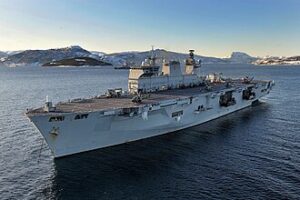
Photo: LA(Phot) Bernie Henesy/MOD, OGL v1.0OGL v1.0, via Wikimedia Commons
Fràoch-class Landing Ship Tank (LST)
The Fràoch-class (heather) was a class of twelve landing ship tanks (LSTs) operated by the Federation Navy from 1976 to 2005. Designed as a replacement for World War II-era amphibious vessels, the Fràoch-class emphasized beaching operations, light infantry transport, and self-defense in regional archipelago scenarios. Construction occurred at three domestic yards, with the lead ship Fràoch (LST-1) commissioning in 1976 and final unit Uig (LST-12) in 1982.
Description
The Fràoch-class hull featured a bow door and ramp for direct beaching, with a 2.0 m draft enabling operations over coral reefs and shallow approaches. The well deck accommodated two LCMs and two LCVPs, while the tank deck held 12 APCs or equivalent cargo (approximately 500 tonnes). CODAD propulsion provided efficient cruising, with diesels alone for 4,500 nm range.
Armament centered on a single 100 mm dual-purpose gun for surface and limited anti-air fire, augmented by twin 30 mm CIWS mounts and 40-barrel 120 mm rocket launchers for saturation defense against missile and air threats. Sensors included the SIOM-45 for air/surface search, with RSMT-22 providing gun/launcher fire control.
All twelve ships entered service between 1976 and 1982, participating in archipelago patrols, humanitarian operations, and Marine battalion deployments. Decommissioning began in 1995, with the class fully retired by 2005 in favor of newer amphibious platforms.
- Service: 1976 – 2005
- Displacement: 3,000 t standard
- Length/Beam/Draft: 91 m/15,1 m/2 m
- Power: 2 × MACO 12V-TDM-462 (6,600 kW each), CODAD, 21 kn, 2 shafts
- Range: 6’500 nm @ 14 kn
- Complement: 85 + 300 marines
- Armament: 1 x 100 mm md. 69 DP gun, 2 x 30 mm/55 md. 69 CIWS, 2 x 40-barrel 120 mm rocket launcher, 2 x 40 twin mm md. 78
- Sensors: SIOM-45 multi purpose radar, SUMA-26 Surface/Navigation radar, RSMT-22 Fire control system, CTAI-32 ESM, ACNA-24 IFF, GTAM-39 decoy launcher
- Capacity: 2 LCM + 2 LCVP + 12 APCs
- Aviation: Landing Pad
- Built: 12 ships
JMSDF, CC0, via Wikimedia Commons
Sruth-class LSL (Landing Ship Logistic)
The Sruth-class (Current) was a class of four landing ship logistics (LSLs) operated by the Federation Navy from 1978 on. Designed as augmentation to the Fràoch-class LSTs, the LSLs provided ro-ro vehicle transport, troop lift, and limited underway replenishment capability for extended amphibious operations. Construction occurred at two domestic commercial yards, with lead ship Sruth-luath (LSL-1) commissioning in 1978 and final unit Sruth-domhain (LSL-4) in 1982.
Description
The Sruth-class featured a ro-ro design with bow and stern ramps enabling rapid vehicle discharge onto unprepared beaches or piers. The 4.0 m beaching draft supported coral reef operations, while the 6.0 m deep load draft permitted UNREP alongside Saorsa AORs. Cargo capacity emphasized wheeled/tracked logistics vehicles over heavy armor, complementing Fràoch LSTs.
CODAD propulsion balanced speed with endurance, maintaining station with 18-knot task groups. Self-defense mirrored contemporary combatants, with the 100 mm gun providing surface fire support and LAR-21 SAMs covering replenishment evolutions.
The four ships supported amphibious task forces through the 1980s-1990s, participating in island-hopping exercises and humanitarian surges. Decommissioning began in 2005, with final retirement in 2010.
- Service: 1978 – present
- Displacement: 5,500 t standard, 7’500 t full
- Length/Beam/Draft: 126 m/18 m/3,7 m
- Power: 2 × MACO 16V-TDM-472 (8,800 kW each), CODAD, 21 kn, 2 shafts
- Range: 7,500 nm @ 15 kn
- Complement: 110 + 500 troops
- Armament: 1 x 100 mm md. 69 DP gun, 2 x 30 mm/55 md. 69 CIWS, 1 x octuple LBT-21 SAM launcher (+16 on magazine), 2 x twin 40 mm md. 78
- Sensors: SIOM-45 multi purpose radar, SUMA-37 Surface/Navigation radar, RSMT-22B Fire control system, CTAI-31 ESM, ACNA-24 IFF, GTAM-39 decoy launcher
- Cargo: 50 vehicles, 2 LCM, 4 LCVP
- UNREP: 2 × heavy jackstay stations
- Aviation: Hangar + deck for 2 × Medium Lift Helicopters
- Built: 4 ships (Sruth-luath (The Fast Flow), Sruth-fuar (The Cold Flow), Sruth-glan (The Clear Flow), Sruth-domhain (The Deep Flow))

Dmgerrard at English Wikipedia, CC BY-SA 3.0 https://creativecommons.org/licenses/by-sa/3.0, via Wikimedia Commons