
Laywenrania, officially the United Communes of Laywenrania (Laywenranian: Co-chomann Aonaichte Laibhenrania), is a sovereign nation comprising an archipelago of more than 1,800 islands in the Eastern Catrutic Ocean, spanning 417,069.8 km². Many islands remain uninhabited, with human settlement concentrated on larger landmasses supporting urban hubs, rainforests, and cooperative industries; the country sustains a population of 32.4 million at a density of 77.7 inhabitants per km².
Renowned globally for its exceptional biodiversity, lush rainforests, pristine beaches, and low crime rates, Laywenrania embodies a decentralized, egalitarian society organized through matrilineal clans and village cooperatives, eschewing a central government in favor of federated communes. A former colony of Harkain, it achieved independence after the Second Cataclysm during the civil War of Independence, subsequently fostering industrial growth in high-end goods, exotic plants, and medical pharmaceuticals—its principal exports—while emerging as a favored ecotourism destination for cultural and natural attractions.
Laywenrania entered the Third Cataclysm to defend its sovereignty and counter Dovithian expansionism. Postwar isolationism yielded to renewed international engagement, including participation in ANAFG peacekeeping operations, standardization conferences, and strengthened diplomatic ties with Keskinen, Harkain, and Hajirah despite ideological variances. Its population, 97% ethnic Laywenranians, upholds near-universal literacy (99.8%) and multilingual proficiency, reinforcing a reputation for high education and cultural independence.
Table of Contents
United Communes of Laywenrania

Use every day to make a better world.
| National Language | Laywenranian |
| Demonym | Laywenranian |
| Formation | Independence 1925 |
| Area | 417’069.8 km2 |
| Population – Census – Density | 32.4 Million 77,7/km² |
| GDP (nominal) – Total – Per Capita | $ 1,85 x 10¹² $ 57’235,51 |
| Gini | 0,23 (low) |
| HDI | 0,969 |
| Currency | Sonus |
| Date format | dd-mm-yyyy |
| Drives on the | left |
| ISO 3166 | UCL |
| Internet TLD | .lay |
History
Tribal Era
Archaeological evidence suggests that humans from the continent of Cela arrived on the archipelago around 41’000 to 43’000 years ago. These settlers possessed advanced maritime skills, using ocean-going vessels to travel between the islands and catch deep-sea fish. Recent research has suggested that people may have arrived as early as 50,000 years ago.
Rising sea levels separated Cela from the landmasses around Australien. A land bridge to Dimasalang existed until around 4,000 BCE, which served as a route of emigration to that area. However, this connection was also severed around 1’000 BCE. Ideal agricultural conditions helped the independent development of agriculture around 7’000 BCE. Trade helped to spread bronze casting, wet-field rice cultivation, new weaving and pottery methods. Although trading occurred with some of the surrounding islands, it took mostly place within the Archipelago. The islands were inhabited by several tribes, including the Fine a Tuath, Fine-fearthainn, Fine-onn, Fine an Iar, Fine de dun, and the Fine de beinn. These Laywenranian speaking tribes were often found raiding and fighting each other. According to oral history, Oébfinn Màthaired, Caelfind Màthaired and Lóegaire Athairiched (Honoured Mother/Honoured Father respectively, an honorific ascribed to these three to acknowledge their importance in securing peace between the tribes and establishing the precursor to the current day federation) consulted with the tribal leaders and were able to convince them to join a confederacy. To commemorate this, a Tree of Peace was planted by all chiefs. The exact date of this occurrence is a matter of debate among scholars, although it is believed that natural disaster forced the tribes to settle their disputes to facilitate survival. Most estimates place the establishment of the confederacy around 1370. This is commonly described as the end of the era of the warring tribes.
The period that followed was marked by an increase in both internal and external trade, including trade with tribes outside of the confederacy, as well as occasional raids between Australien and Laywenranian tribes. These raids were akin to elaborate sparring matches, and were typically not lethal. Traditional weaponry included bows, spears, war hatchets with flint steel and obsidian, and clubs. Agriculture enabled the tribes to support a growing population. The Confederacy was represented by a High Council. Each clan of each tribe sent a delegate who was elected by the people of the clan. Upon election, the delegate relinquished their old name and was thereafter addressed by their title. Political and diplomatic decisions were made on the local level of the clan, with the Tribal Council and the High Council serving a ceremonial role and coordinating the efforts of the matrilineal clans and tribes. Consensus was required for decision-making. The councils’ delegates were subject to recall by the clans at any time. The tribes also had the power to veto declarations of war and treaties.
Colonialism
First contacts with the Por-Or tribe from Harkain were generally peaceful and limited to brief visits for exploration and mapping. However, this tranquillity was short-lived as Por-Or merchants sought business opportunities and were not averse to using violence to maximise profits. This resulted in violent clashes with the Laywenranian tribes, although most skirmishes occurred in coastal areas as Por-Or soldiers were reluctant to venture into the jungle. With the occupation of the important trade ports the Por-Or merchants could establish a certain dominance in the area and forced concessions from the various tribes, mostly to force them into unfavourable trade deals to gain access to the exotic plants growing in the tropical climate, including but not limited to various spices, fruits and tea. However, their control over Laywenrania was still tenuous at best and nominal at worst. After multiple decades of more or less openly hostile relationships, the Por-Or adopted a more friendly approach to gain the support of the locals. During this period the colony was mostly handled as business venture. Merchants invested money in plantations and workshops, employed local workers, and profited from buying goods and exporting them to Harkain and other areas of the NWP.
With the threat of war looming on the horizon, Laywenrania was seen as a key colony due to its strategic position in the Eastern Catrucic Ocean and its supply of rubber. As a result, local war industries were established, including small arms factories, civilian and military naval yards, as well as automotive and aviation industries. In addition, the Laywenranian Navy was equipped with small sloops to support local naval missions. These were later supplemented with foreign designed but locally built torpedo boats, torpedo boat destroyers, cruisers and cargo ships. Laywenrania was granted a certain autonomy in exchange for the promise to participate on the side of the Por-Or in the upcoming war. This was a significant change for the mostly agrarian landscape of Laywenrania and led to increased exploitation of natural resources.
Second Cataclysm and War of Independence
During the Second Cataclysm, Laywenrania supported Harkain’s war efforts with their Expedition Corps. They provided escort for convoys and supplied merchant ships.
Following the Second Cataclysm, the Por-Or tribe encountered significant internal issues and lost its dominant position during the Harkain Second Tribal War. This development resulted in a loss of control over its colonies. The dissatisfaction with Harkain’s control over Laywenranian affairs led to several uprisings in Laywenrania. These uprisings culminated in the War of Independence against the remaining Por-Or garrisons, as well as an internal civil war between the different political factions. The three main factions were the right-wing Comannh-daingeanh party, the parliamentarian-capitalist leaning Saor-mhargadh and the communal libertarian Co-chomann Aonaichte. The Co-chomann Aonaichte received significant support from traditional tribes and villages and had strong ties to the rural population. On the other hand, the Saor-mhargadh was primarily rooted in the upper classes and had close ties to Por-Or merchants. The Comann-daingean, meanwhile, was largely composed of urban middle-class individuals and received support from industrial leaders.
Despite the growing industrialisation, the War of Independence was primarily fought with infantry. The majority of Por-Or troops withdrew, leaving the remaining troops to concentrate in major port cities and form an uneasy alliance with the Saor-mhargadh, who could only provide smaller numbers of troops. In the jungles, highlands and villages, a fierce battle between Co-chomann Aonaichte and Comann-daingean took place. The Co-chomann Aonaichte gradually gained the upper hand, thanks to the support of the local population and especially the Clan Mothers, with whom they shared a similar vision for the future of the country. Propaganda efforts, which often relied on family ties, led to increasing support for this alliance. The final battles of the war took place in the coastal towns occupied by the Por-Or forces. Initially, the Por-Or forces had the upper hand due to their access to armoured cars. However, due to the lack of supplies, Laywenranian forces retook town after town until the last Por-Or forces were driven out of Laywenrania. In 1925, Laywenrania officially declared its independence. Following the loss of the Second Tribal War by the Por-Or in Harkain, the new Harkain government acknowledged the declaration of independence.
The War of Independence left scars in the Laywenranian society that needed healing. The old societal principles, which were partially lost during the Por-Or’s rule, particularly in coastal areas and cities, were officially re-established. For the first time in over a century, a High Council was elected. The resulting political ideology was a unique blend of Laywenranian tribal culture and overseas political ideas. In the subsequent years, Laywenrania concentrated on building up its heavy industry in order to provide the military with modern equipment, from rifles to ships. This would allow for the local production of the machinery and civilian products necessary for a robust economy, thus reducing the country’s dependence on agricultural products. Laywenrania adopted the Sonus, and subsequently became a member of the International Standardisation Conference.
Third Cataclysm and Aftermath
Laywenrania was hit by the Third Cataclysm while still recovering from the War of Independence and the Second Cataclysm. Once again, Laywenrania found itself at war, this time fighting alongside Harkain against the nationalist and fascist Axis led by Dovithian. To equip the Armed Forces, a massive emergency program was initiated, heavily relying on domestic production due to the strained supply situation of Laywenrania’s allies. While the army provided Expeditionary Forces to support allied land campaigns, the navy provided convoy escorts and raided enemy shipping lanes. Laywenrania send supplies of canned fruit, rubber, tea, fish and meats to their allies.
Era of the Space Race
Following the conclusion of the Third Cataclysm, Laywenrania entered an isolationist era. National programmes were implemented to rebuild the country’s civilian capacity, resulting in internal struggles to modernise traditional practices. While other nations were competing to put the first human in space, Laywenrania prioritised achieving as much autarky as possible.
Modern History
Over the last three decades, Laywenrania has taken a more active approach to international diplomacy. In a drastic turn of events, Laywenrania joined the ANAFG (Allied Nations Against Foreign Aggression), withdrawing after disputes and later joining the ANMP (Allied Nations for Mutual Protection). Additionally, Laywenrania joined The New Warsaw Pact Workingmen’s Congress as an observer and entered into a research agreement with Harkain. Laywenrania has also played an active role in promoting sustainable and medical technologies. In line with its agreement with Harkain, Laywenrania has entered into a research agreement with the Great Lakes Nations to develop future automotive technologies.
The shift in foreign policy was driven by the increasingly aggressive foreign policies of other nations. To safeguard the federation, Laywenrania actively engaged in the ANAFG and the ANMP. It also cooperated with Keskinen on military technology. During the 2016 Pomontanium campaign against Hajirah, Laywenrania covertly provided arms and training to Hajirah, aiding in its defence against the invasion of its land. This formed the basis for a tentative relationship with the authoritarian and religious Arab state.
Due to growing discontent with the politics and inaction of the ANMP in light of the aggressive actions of some of its member states, Laywenrania actively engaged in conferences to sanction the states in breach of the ANMP Charter.
Geography
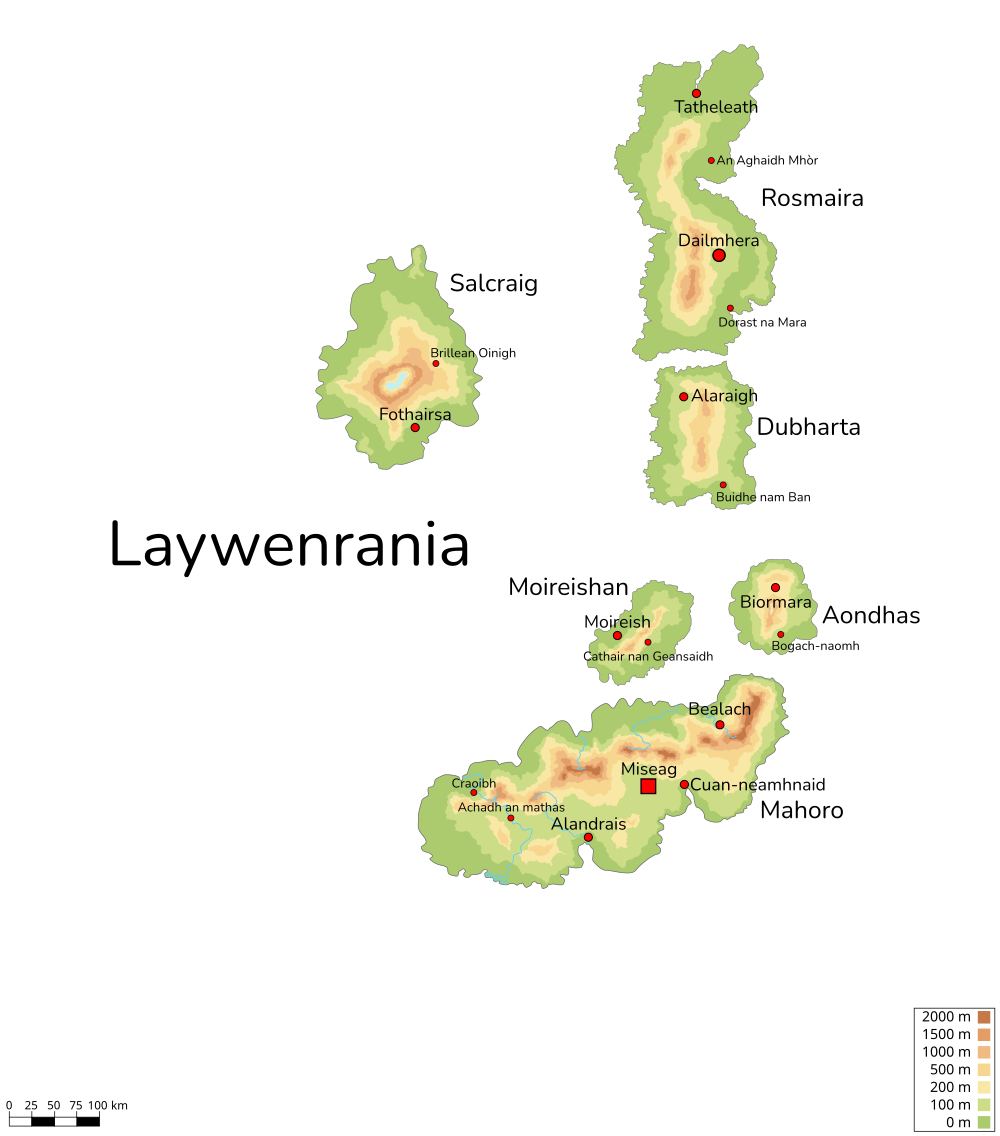
Laywenrania encompasses a total land area of 417,069.8 km² distributed across more than 1,800 islands in the Eastern Catrutic Ocean. The archipelago remains geographically isolated, with Dimasalang lying 500 km distant at its closest approach, Damanucus 1,350 km to the north, Altaggannah 1,780 km to the west, and the Australian landmass positioned to the south.
A few larger islands support the bulk of the population and infrastructure, while hundreds of smaller islets serve specialised roles in fishing, conservation, and eco-tourism. The landscape features rugged central highlands, extensive tropical rainforests, coastal mangrove swamps, and fertile wetlands along the major rivers Wíbanedimil and Lana. The highest peak, Beinn Mhòr na h-Eala (3,744 m), anchors the principal mountain range, where deeply incised valleys and glacial cirques testify to past climatic shifts.
Coasts are characterised by rocky cliffs, sheltered bays, expansive coral reefs, and offshore atolls. Remnants of ancient tectonic convergence have uplifted the archipelago’s terrain and left scattered dormant volcanoes, with seismic activity now infrequent. Historical land bridges formerly connected Laywenrania to Australien and Dimasalang until approximately 4,000–1,000 BCE, influencing early human migration and biogeographical patterns.
This varied topography fosters pronounced microclimates and supports diverse cooperative land uses: highland agroforestry, lowland plantations, riverine fisheries, and marine protected areas. The geography underpins the federation’s economic resilience, transport networks, and cultural traditions tied to island stewardship.
Climate
Laywenrania features a tropical monsoon climate with oceanic moderation across its lowlands and a cooler highland variant at elevation. Positioned approximately 10° south of the equator, the archipelago records average annual temperatures of 20–25°C, with coastal lowlands maintaining 24–28°C year-round and highland interiors averaging 14–18°C. Rainfall proves copious and seasonally pulsed, totalling 2,000–4,000 mm annually archipelago-wide, though windward mountain slopes accumulate up to 7,000 mm during peak wet periods.
Highland zones display sharper diurnal contrasts and occasional frosts or rare snowfall on summits above 3,000 metres, such as Beinn Mhòr na h-Eala (3,744 m), where orographic lift from saturated air masses generates transient frigid conditions. The national mean temperature registers 22°C, driven by steady trade winds that ensure verdant growth across a 405-day solar year, punctuated by brief drier interludes rather than prolonged droughts.
Ancient tectonic legacies underpin mild seismic risks and dormant volcanism, stabilised over geological epochs. This climatic profile nurtures tiered microclimates—from mangrove fringes and rainforest canopies to upland cloud forests—sustaining cooperative agriculture, fisheries, and biodiversity vital to the federation’s dispersed island geography.
Flora and Fauna
Laywenrania hosts an exceptionally diverse array of flora and fauna, shaped by its tropical rainforests, coastal ecosystems, highland environments, and geographical isolation across 1,800 islands. The archipelago’s lack of recent land bridges has fostered unique evolutionary divergence, with numerous endemic species found nowhere else. This biodiversity underpins the economy through agroforestry, medical research, fisheries, and eco-tourism, while also supporting traditional practices and ecological stewardship.
Lowland rainforests dominate the larger islands, characterised by multi-layered canopies of dipterocarp trees, palms, figs, and lianas. Notable species include the towering Laywenranian ironwood (Dracaena laibhenrana), valued for its durable timber, and the rainbow canopy orchid (Phalaenopsis moireish), which produces vivid floral displays and medicinal extracts. Understorey plants such as gingers, ferns, and bromeliads thrive in the humid conditions, many yielding spices, teas, and herbal remedies used locally and exported.
Highland forests, above 1,000 metres, transition to oak, red cedar, pine, and beech assemblages, interspersed with montane cloud forests. The Beinn Mhòr na h-Ealasilver fir (Abies Beinn Mhòr na h-Eala) is a keystone species at higher elevations, where equatorial snowfalls create rare microclimates. Epiphytic mosses and lichens dominate these zones, contributing to water retention and nutrient cycling.
Mangrove swamps line much of the coastline, forming critical buffers against storms and erosion. Species such as red mangroves (Rhizophora spp.) and nipa palms support intertidal fisheries and provide materials for construction and crafts.
Fauna
Laywenrania’s fauna reflects its prolonged isolation across 1,800 islands, fostering high endemism among mammals, birds, reptiles, amphibians, and insects.
Mammals include the elusive Laywenranian cloud leopard (Neofelis laibhenrana), a mid-sized predator adapted to rainforest canopies; the archipelagic tree kangaroo (Dendrolagus insularis), an arboreal herbivore foraging in upper forest layers; and numerous bat species, including fruit bats critical for seed dispersal. Smaller mammals such as civets, pangolins, and endemic rodents occupy niche roles.
Birds are particularly diverse, with over 400 species recorded. The imperial hornbill (Buceros moireish), a large fruit-eating bird with iridescent plumage, serves as a canopy engineer. Seabirds like frigatebirds, penguins and terns nest on smaller islets, while highland raptors such as the Aquila altissima patrol montane ridges. Parrots, pittas, and sunbirds add colour to the forests.
Reptiles and amphibians flourish in the wet climate. The emerald tree monitor (Varanus viridis laibhenrana), an arboreal lizard reaching two metres, preys on birds and insects. Freshwater crocodiles inhabit rivers and wetlands, alongside poison-dart frogs and caecilians unique to highland streams.
Marine life surrounds the archipelago, with coral reefs supporting parrotfish, groupers, and sharks. Coastal waters host sea turtles, dugongs, and cetaceans, while deep-sea fisheries yield tuna and billfish. The Laywenranian reef manta (Manta laibhenrana) is a flagship species for conservation.
Conservation and utilisation
Cooperative stewardship integrates biodiversity with human activity. Village councils regulate harvesting through seasonal quotas and no-take zones, while regional federations oversee protected areas covering 25% of land and 30% of marine territory. Endemic species inform pharmaceutical development—compounds from orchids and frogs contribute to global medical exports—and agroforestry sustains timber, rubber, and spice production without large-scale clearing.
Tourism benefits from guided eco-tours, birdwatching, and diving, generating revenue for habitat restoration. Research stations on major islands collaborate with universities to monitor populations and climate impacts. This balanced approach maintains Laywenrania’s ecosystems as both national assets and global biodiversity hotspots.
Politics
Laywenrania is a segmentary, consensus-based federation organised around matrilineal clans, villages, tribes, and regional confederacies. Political power is decentralised by design, with decisions made at the lowest practical level through elected and recallable delegates. This structure preserves the egalitarian traditions of the tribal era while accommodating the needs of a modern archipelagic state.
Administrative Divisions
Local Governance
The basic unit of governance is the village cooperative, typically comprising several matrilineal families or clans. Each village elects a council responsible for administration, resource allocation, and local jurisprudence under tribal customary law. Council members serve the community and can be recalled by a simple majority vote at any time. Major changes to laws, land use, or customs require approval from two-thirds of adult clan members, ensuring broad legitimacy while allowing routine matters to proceed efficiently.
Villages coordinate through clan assemblies, where family representatives discuss shared interests such as markets, fishing rights, or cooperative ventures. Leadership roles, including temporary positions like resource stewards or mediators, are assigned based on skill and consensus rather than heredity or wealth.
Tribal and regional structure
Multiple clans form a tribe, and multiple tribes form a regional confederacy. Each village sends a single delegate to the tribal council, elected by popular vote and subject to immediate recall. Tribal councils handle coordination across villages—such as regional transport schedules, crop exchanges, or disaster preparedness—but lack authority to override local decisions. Similarly, tribal delegates represent their region at the federal level, serving coordinating rather than commanding roles.
This tiered structure prevents administrative slowness through structured delegation. Delegates operate within explicit, time-bound mandates (e.g., “negotiate ferry routes for six months”), allowing 80–90% of governance to occur via empowered representatives. Urgent issues bypass full assemblies via pre-ratified protocols, with fixed discussion periods (7–14 days locally, up to 30 days regionally) ensuring timely resolution.
Institutional safeguards
Laywenrania’s system addresses the challenges of scale through deliberate safeguards embedded in the Federal Treaty of Cooperation (ratified 1925, updated decennially by two-thirds consensus):
- Population-weighted representation prevents larger islands from dominating, with annual audits by independent clan facilitators.
- Mandatory rotations and lotteries: Delegates serve 2–3 years maximum per level, with reserved slots for small-island and rural voices selected by lot.
- Transparency mandates: All meetings are public or streamed, decisions archived digitally, and cooperative budgets openly audited.
- Federated veto thresholds: Regions representing >25% of population can veto federal actions only if they offer viable alternatives.
- Integrity circles: Violations prompt investigations by citizen panels from diverse regions, with automatic recalls for misconduct.
These ensure accountability without hierarchy. During crises, elected commanders and technical circles (e.g., engineers, medics) gain delegated powers under the same recall rules, enabling rapid response while preserving postwar review.
Political culture
Laywenranian politics emphasises rotation, skill, and collective stewardship. Temporary leadership emerges from demonstrated competence, not permanent office. The militia system mirrors this: volunteers elect commanders based on merit, with discipline agreed by assemblies. Factionalism is mitigated by cross-clan marriages, market exchanges, and shared rituals that reinforce unity.
Historically rooted in the 1370 confederacy, the system blended tribal practices with post-independence innovations, rejecting both colonial hierarchies and centralised alternatives. It has proven resilient through the Third Cataclysm, natural disasters, and modern diplomatic challenges, balancing local autonomy with national coherence. Laywenranians describe it as “consensus with structure”—flexible for daily life, robust for survival.
Foreign Relations
Laywenrania pursues a foreign policy of principled independence, self-reliance, peace, cooperation, and humanitarian commitment, actively participating in international alliances to safeguard its sovereignty while prioritising self-determination and aid. As a member of the ANMP (Allied Nations for Mutual Protection), it contributes medical personnel, disaster relief teams, and peacekeeping forces, reflecting a strong emphasis on global stability without entanglement in great-power rivalries.
Historically, Laywenrania joined the ANAFG (Allied Nations Against Foreign Aggression) to counter external threats but grew sceptical of its effectiveness following the unaddressed aggression by one member state against Hajirah. Despite Laywenranian support for Hajirah’s defence—through covert arms, training, and diplomatic pressure—the ANAFG’s inaction highlighted structural weaknesses, prompting withdrawal and transition to the ANMP. This newer alliance, sharing many members but designed to enforce mutual accountability, better aligns with Laywenrania’s expectations for collective security.
The federation maintains observer status in the New Warsaw Pact Workingmen’s Congress and research partnerships with Harkain, Keskinen, and the Great Lakes Nations, focusing on sustainable technologies, medical advancements, and automotive innovation. Diplomatic ties with Hajirah persist, rooted in shared resistance to aggression.
Laywenrania intervenes primarily through humanitarian channels—deploying doctors, engineers, and supplies to disaster zones—and supports self-determination movements diplomatically. Neutrality prevails in intra-alliance disputes lacking clear humanitarian imperatives, but red lines include crimes against humanity, unprovoked invasions, and suppression of communal self-governance. Violations prompt sanctions advocacy, aid embargoes, or withdrawal from ineffective bodies, as demonstrated by the ANAFG experience.
Post-1990, embassies in key Catrutic Ocean and regional states foster trade, cultural exchange, and conflict prevention. This pragmatic stance balances alliance benefits with autonomy, ensuring Laywenrania’s security without compromising its core values.
Military
The Laywenranian Armed Forces combine a voluntary militia foundation with a professional core cadre, balancing broad civic participation with high-intensity operational capability. Officers and commanders are elected by their units based on merit and experience, operating within a structured command chain that ensures unity during complex missions. Ground Forces, Air Force, and Navy field indigenous high-tech systems—multirole fighters, guided-missile destroyers, precision artillery—produced by worker cooperatives.
The militia forms the bulk of wartime strength, with volunteers trained to operate both basic and advanced systems. They reinforce professional crews on jets, ships, and missile batteries during mobilisation, providing scalable manpower for territorial defense, logistics, and high-tech operations. Militia members store their rifles at home for rapid deployment and participate in regular refreshers.
A permanent professional cadre (20–30% of total strength) maintains peacetime readiness, expeditionary forces, and strategic assets. Recruited from elite militia graduates, they serve renewable contracts approved by unit vote, focusing on joint operations, air defense, and naval power projection.
Command authority flows through elected officers with explicit, time-bound mandates from higher echelons. Platoon to squadron leaders are elected every 1–2 years by secret ballot among qualified personnel. Campaign commanders, appointed by the elected Federal Military Council, receive full delegation until mission completion or recall. Technical circles of specialists advise and execute delegated tasks, rotating to prevent entrenchment.
A strong sense of patriotism—rooted in the 1925 War of Independence—sustains high volunteer participation. The Forces emphasise defensive depth and rapid scaling: professionals handle peacetime tasks while militia bolsters numbers for sustained conflict. Total standing strength reaches ~190,000, capable of coalition operations through federation alliances.
Demographics
Laywenrania maintains a population of 32.4 million (latest census), yielding a density of 77.7 inhabitants per km² across its 417,069.8 km² archipelago. This reflects concentrated settlement on larger islands, where urban hubs, administrative centres, and industrial cooperatives house ~65% of residents, while smaller islets support sparse fishing communities and ecological stations.
The population remains predominantly homogeneous, with 97% ethnic Laywenranians tracing descent through matrilineal clans. Remaining groups include longstanding communities from Australien (1.2%, primarily coastal traders), Harkain (0.8%, urban professionals), and Dimasalang (0.4%, maritime specialists). The Por-Or tribe from Harkain, arriving as refugees during the Second Tribal War (1920s), integrated fully into adopting clans and now constitutes ~0.3% through cultural syncretism.
Recent decades saw modest inflows of NWP refugees (0.5%), paired with host-family integration mirroring traditional adoption practices. Immigrants learn Laywenranian through immersion, participate in gender-spirit ceremonies, and join village cooperatives, achieving high assimilation rates within one generation.
Age structure skews youthful (median age 31.2 years), with 24% under 15 and 12% over 65, reflecting stable fertility (1.9 children per woman) and high life expectancy. Urbanisation stands at 62%, concentrated on principal islands, while rural/island populations sustain cooperative agriculture and fisheries.
Migration remains internal and modest: highland youth seek urban training before returning to villages, while islanders rotate through mainland apprenticeships. Cooperative equalisation funds mitigate regional disparities, maintaining equitable living standards across the federation’s dispersed geography.
Language
Laywenranian serves as the sole official language, spoken fluently by nearly all residents and featuring a unique script developed during millennia of archipelagic isolation. Evolving from ancient Cela migrations, it incorporates melodic intonation, complex consonant clusters, and vocabulary rich in ecological and kinship terms. The script employs 28 characters with diacritics for vowels and mutations, reflecting phonetic precision suited to oral traditions and digital encoding.
Multilingualism remains widespread: 85% speak Common as the established trade, diplomacy, and federation-wide lingua franca, facilitating inter-island coordination and external relations. 12% retain Harkain New Yorn-Har, a colonial-era dialect preserved among urban communities and Por-Or descendants, often used in historical scholarship and maritime terminology.
Laywenranian dominates education, media, and governance, with Common supplementing technical and international contexts. Village immersion ensures early fluency, while secondary schools offer bilingual instruction. Digital platforms preserve oral literature in both languages, and translation cooperatives support global engagement. This linguistic structure reinforces cultural cohesion across the dispersed archipelago while enabling pragmatic connectivity.
Religion
The Federal Treaty of Cooperation guarantees freedom of belief and freedom from religion, reflecting Laywenrania’s egalitarian emphasis on personal conscience and communal harmony. Organised religion plays a limited role in national life, with 87% of Laywenranians identifying as non-theist and the majority adhering to no formal doctrine. Spiritual practices, when present, manifest through localised folk traditions rather than institutional hierarchies.
Laywenranian folk spirituality centres on animistic reverence for land, sea, and ancestral spirits, integrated into daily stewardship rather than separate worship. Village medicine persons lead seasonal rites—offerings at sacred groves, river blessings, and equinox gatherings—that blend practical ecology with communal reflection. These ceremonies reinforce matrilineal bonds and gender-spirit alignment without mandating belief or creating clergy.
Minority faiths comprise 8.1% adherents to Harkain LarkJac (introduced through colonial ties and refugee communities) and smaller groups following imported traditions from Australien, Dimasalang, or global diaspora. Por-Or spiritual practices persist among adopted clans, often syncretised with local animism. All faiths operate through voluntary associations, with no state funding or privileged status.
Religious expression occurs primarily in private family settings or voluntary circles, aligning with the society’s decentralised structure. Interfaith dialogue flourishes at markets and councils, where shared values of cooperation supersede doctrinal differences. Laywenrania’s approach treats spirituality as personal enrichment supporting collective wellbeing, rather than a basis for authority or division.
Health
Laywenrania maintains universal healthcare delivered through a highly integrated system of village practitioners, outpatient clinics, regional hospitals, and specialist centres on major islands. The doctor-to-population ratio stands at 1:180, among the world’s most favourable, enabling comprehensive primary care across the archipelago. Life expectancy reaches 79 years for men and 82 years for women, with infant mortality at 4 per 1,000 births and under-5 mortality at 7.4 per 1,000.
Preventive care forms the cornerstone, with village-level screening, vaccination programmes, and maternal health services integrated into cooperative life. Every village hosts a medical practitioner trained in both modern pharmaceuticals and traditional herbal remedies, addressing common ailments from venomous bites to respiratory infections. Free medicines and treatments eliminate financial barriers, while telemedicine connects remote islets to urban specialists.
Hospital infrastructure meets international standards, particularly in maternal and child health. Tuberculosis incidence remains low at 7 per 100,000, and work-related accidents register 1.6 per 1,000 workers annually. Probability of mortality between ages 15–60 stands at 115 per 1,000 for men and 73 per 1,000 for women. Cooperative funding sustains the system without private insurance, supplemented by regional equalisation funds for island disparities.
The active lifestyle—hiking, fishing, archery—bolsters outcomes but carries risks from the archipelago’s biodiversity, including venomous flora and fauna. Disaster medicine receives special emphasis, with militia-trained medics and prepositioned supplies countering earthquakes, volcanic eruptions, and cyclones. Laywenranian medical teams deploy internationally for humanitarian missions, sharing expertise in tropical diseases and trauma care while maintaining domestic resilience.
Education
Laywenrania’s education system delivers universal access through village-level kindergartens, comprehensive schools, secondary tracks, and tertiary institutions concentrated on larger islands. Education emphasises practical skills, civic participation, and ecological stewardship alongside academic excellence, preparing citizens for militia service, cooperative workplaces, and federated governance.
Kindergarten operates at village level, serving children from infancy through age six. Communal facilities raise multiple families’ children together, fostering early social bonds, language immersion in Laywenranian, and basic motor skills through outdoor play and cooperative tasks.
Compulsory basic comprehensive schooling spans ages 7–16, delivered through island schools teaching core subjects—literacy, mathematics, natural sciences, history, archery, and cooperative principles. Gender-spirit ceremonies integrate with age 14–16 curricula, blending personal reflection with communal responsibility.
Secondary education divides into academic and vocational tracks, each lasting three years. Academic streams prepare for university research or administration; vocational programmes train for cooperative industries—shipbuilding, agroforestry, medicine, rail operations, airship maintenance. Both culminate in qualifications for tertiary study or direct workforce entry.
Tertiary education comprises science-oriented universities on major islands and polytechnic institutes offering applied training. Universities emphasise cooperative research in pharmaceuticals, renewable energy, and IT; polytechnics produce skilled tradespeople for regional federations. Distance learning via fibre networks reaches remote islets, while work-study apprenticeships blend formal education with cooperative employment.
Education funding flows through village cooperatives and equalisation funds, ensuring uniform quality without private tuition. Adult refreshers—bi-annual militia training, technical upskilling—extend lifelong learning. The system produces high literacy (99.8%), strong STEM participation, and graduates who seamlessly integrate into the federation’s decentralised structure, sustaining Laywenrania’s HDI of 0.969.
Cities
Economy
Laywenrania’s economy is based on worker self-management, cooperative ownership, and federated coordination. Production is organised through village cooperatives, worker cooperatives, and regional councils, which together coordinate agriculture, fishing, industry, transport, and public services without relying on private capital or a centralized command economy.
Land is generally held in stewardship rather than as private property, and most rural production is managed at the local level. Larger enterprises, including factories, shipyards, processing plants, and transport networks, are run by their workers through elected assemblies and delegated management. National and regional bodies primarily handle standards, infrastructure, strategic resources, and long-term planning.
The system is well suited to Laywenrania’s geography. The larger inhabited islands host the main industrial, administrative, and transport centers, while smaller islands and islets specialize in fishing, agriculture, tourism, and local production. Inter-island trade and transport are essential to the economy, and surplus goods are exchanged through regular markets and cooperative logistics networks.
Major sectors include agriculture, fishery, renewable energy, pharmaceuticals, industrial goods, timber, telecommunications, and tourism. The economy is strongly export-oriented in selected sectors, but it remains focused on self-reliance, resilience, and equitable distribution within the federation.
Resources
Laywenrania’s natural resource base is defined by its equatorial, high-rainfall topography and complex volcanic geology, managed entirely under collective stewardship to prioritise ecological resilience over rapid extraction. The nation’s agricultural cooperatives leverage diverse microclimates to cultivate a wide array of arable crops, ranging from staple foods like rice, maize, beans, soy, yuca, and yam to vital cash crops and exotics including sugarcane, vanilla, black pepper, onions, and tea. Coastal and lowland networks focus extensively on sago palm processing, while agroforestry methods support highly productive orchards of avocado, papaya, orange, mango, and banana, alongside cocoa and rubber—a legacy of the colonial plantation era now managed sustainably.
Highland rainforests and managed silviculture zones provide premium timber, high-density hardwoods, and flexible bamboo used for domestic construction and artisanal industries without resorting to clear-cutting. Beneath the soil, selective, closed-loop mining operations on the larger volcanic massifs extract essential copper, bauxite, and rare-earth elements for high-tech domestic manufacturing, while abundant sedimentary deposits supply limestone and high-grade silica sand for the nation’s glass-fibre telecommunications infrastructure.
Marine resources are equally vital; strictly regulated cooperative fisheries and mariculture networks harvest sustainable yields of pelagic fish, crustaceans, and kelp, while the pristine biodiversity of the coastal mangroves serves as the primary testing ground for bioprospecting, feeding organic compounds directly into the domestic pharmaceutical sector. This diversified material wealth is underpinned by total energetic self-reliance, powered entirely by indigenous renewable resources including run-of-the-river hydroelectricity, equatorial solar arrays, coastal wind networks, and deep geothermal wells that insulate the archipelago from external resource volatility.
Infrastructure
Laywenrania’s infrastructure is designed for archipelagic connectivity, prioritising inter-island integration over long-distance overland corridors. On the larger inhabited islands, electrified metre-gauge railways form the backbone of transport, linking ports, industrial zones, administrative centres, and market towns. Higher-speed rail connects major urban hubs, while roads, buses, and local services support shorter journeys. Car ownership remains low, with most travel made by rail, foot, bicycle, or maritime routes.
Ports and ferries are essential, handling bulk trade, inter-island cargo, fishing, and passenger movement. Major ports such as Alandrais, Cuan-neamhnaid, Dorast na Mara, and Tatheleath serve as national logistics hubs, while smaller jetties connect remote communities. Two international airports (Miseag and Dailmhera) and numerous smaller airstrips support long-distance travel and emergency access.
Airships provide ecological transport for light freight, mail, medical deliveries, and scheduled passenger service between islands, particularly where low environmental impact and flexible routing are needed. They complement ferries and short-haul aircraft without replacing them.
The country maintains extensive telecommunications with mobile internet and glass-fibre networks, essential for coordinating cooperatives, healthcare, education, and disaster response across dispersed settlements. Renewable energy dominates electricity production: hydroelectricity (61%), solar (26%), wind (8%), and geothermal (5%). Energy systems combine regional grids on larger islands with local microgrids on smaller ones, ensuring resilience against storms and seismic activity.
Public services such as healthcare and education follow the same distributed model, with village-level access backed by regional hospitals, schools, and higher education concentrated on major islands. This infrastructure supports Laywenrania’s cooperative economy and consensus politics while accommodating its challenging geography.
Tourism
Laywenrania ranks as the premier tourist destination in the NWP, contributing substantially to GDP through its pristine natural beauty, culture, and hospitality. Annual visitors exceed 5 million, drawn to the archipelago’s diverse attractions managed through village collectives and regional eco-tourism federations.
Natural attractions dominate: guided rainforest treks reveal endemic flora and cloud leopards; highland trails ascend Molewehanu for equatorial snow vistas; coastal itineraries combine scuba diving on vibrant reefs with penguin observation at islet colonies. Kayaking mangrove labyrinths, river rafting, and bioluminescent night tours showcase biodiversity under sustainable quotas.
Cultural immersion offers village homestays, gender-spirit ceremonies (observer status), archery workshops, and weekly market festivals featuring tapa cloth dyeing, nine-verse poetry recitals, and clàrsach performances. Rugby tournaments and sailing regattas provide competitive spectatorship, while cooking classes teach rabothili ana preparation and sago processing.
Infrastructure supports accessibility: airship scenic flights connect remote islets; electrified rail links major hubs; ferry networks serve eco-lodges. Laywenranians rank consistently among the region’s most welcoming hosts, with cooperative guides ensuring authentic experiences over commercial extraction.
Revenue funds habitat restoration (25% reinvested), capacity controls prevent overcrowding, and visitor levies support equalisation funds. Peak seasons align with Harvest Convergence and Year-Tide Renewal holidays, blending tourism with communal celebration while preserving the federation’s ecological and social fabric.
Culture
Laywenranian culture centres on humanity, harmony, and collective stewardship, with the extended family as the foundational social unit. Land stewardship passes through matrilineal lines to the designated family member—typically the youngest aligned with the matrilineal gender-spirit—but any qualified individual may assume this role. Gender-spirit identification, discerned during a coming-of-age ceremony (typically ages 14–16, revisable later), aligns individuals with societal poles of stewardship (nurturing/land-holding), action (outward/protective), or mediation (integrative/diplomatic). This ceremonial-personal guidance carries no legal force; official documents recognise only name and clan affiliation, ensuring unqualified equality.
Upon partnership, couples often join one partner’s family house—the physical and social nucleus of communal life—or establish balanced households. Names comprise a given name (evolvable over time, reflecting life changes) and parental clan names; adopted individuals typically take adoptive clan names while optionally retaining originals. The village medicine person, inherited within clans, serves as healer (blending herbal remedies with modern pharmaceuticals), spiritual guide, and neutral counsellor in disputes.
Arts and Media
The constitution guarantees freedom of speech and press. Tribal newspapers have transitioned to digital platforms, reaching remote islets via satellite and fibre. Local radio broadcasts weather, markets, and oral histories, while national television and a federated streaming service offer dramas, documentaries, entertainment, movies, and live council proceedings.
Laywenrania maintains a rich tradition of folk literature based on a nine-verse poetic form, chronicling clan histories, births, marriages, migrations, and natural events. Scribes preserve these in digital archives, with annual recitation festivals reviving oral performance.
Music spans traditional ensemble playing on carved wooden drums, bamboo flutes, and six-string clàrsach, accompanying trance dances and healing rites. Modern fusion incorporates electronic synthesisers and global rhythms, prominent at island festivals and cooperative sound collectives.
Sport
Archery reigns as the national sport, practised with ritual discipline on village ranges using recurve bows of layered wood and horn. Contests emphasise form, breath control, and communal harmony, with master archers mentoring youth through years of graded training.
Rugby enjoys international prominence, with national teams consistently medalling in regional competitions. Badminton and volleyball suit humid climates; chess variants test strategy at markets; sailing regattas race traditional outrigger canoes; and football draws crowds to coastal pitches.
Cuisine
Cuisine emphasises fresh, local ingredients, varying by ecology and historical influences. Coastal staples include rabothili ana (stir-fried eel with rice, papaya, and black pepper) and grilled reef fish wrapped in banana leaves. Highland dishes feature yam and sago stews thickened with maize, spiced tea broths, and roasted avocado with wild herbs. Riverine communities favour fermented fish pastes and bean cakes. Communal market meals blend these with tropical fruits (mango, guava), vanilla-infused desserts, and palm toddy beverages. Preservation via smoking, salting, and fermentation supports inter-island trade.
Clothing
Traditional attire utilises tapa cloth—beaten bark from mulberry and banana plants—dyed with plant extracts in earth tones and geometric patterns symbolising clan histories. Sarong-style wraps with shoulder shawls serve daily wear; lungi-like kilts and sleeveless tunics suit men. Gender-spirit influences ceremonial accessories: stewards don floral mantles, mediators feathered headdresses, action-aligned wear shell armbands. Modern urban clothing blends tapa textiles with cooperative-made quick-dry fabrics and insect-repellent weaves for rainforest work.
Holidays
Laywenrania follows a 405-day calendar aligned to lunar cycles: ten 40-day months (four 10-day weeks each), with five intercalary days of celebration at year-end marking renewal. Major holidays include:
- Tree of Peace Planting (Month 1): Confederacy unification with communal tree ceremonies and poetic recitals.
- Independence Renewal (Month 3): 1925 victory with militia parades, fireworks, and clan feasts.
- Gender-Spirit Awakening (Month 5): Youth ceremonies with masked dances and archery initiations.
- Harvest Convergence (Month 7): Rotating inter-village markets with rugby matches, music, and feasting.
- Beinn Mhòr na h-Eala Vigil (Month 9): Highland pilgrimage honouring the peak with fire dances and stargazing.
- Year-Tide Renewal (intercalary days): Five days of island-hopping celebrations, cleansing river processions, and market closures for reflection.
Equatorial rains inspire water-based rituals celebrating abundance amid constant verdancy.